Showing posts with label book. Show all posts

Saturday, July 6, 2013

Robert Louis Stevenson - The Silverado Squatters (1883)


The Silverado Squatters (1883) is Robert Louis Stevenson's travel memoir of his two-month honeymoon trip with Fanny Vandegrift (and her son Lloyd Osbourne) to Napa Valley, California, in the late spring and early summer of 1880.

The Silverado Squatters provides some interesting views of California during the late 19th century. Stevenson uses the first telephone of his life. He meets a number of wine growers in Napa Valley, an enterprise he deemed "experimental", with growers sometimes even mislabeling the bottles as originating from Spain in order to sell their product to skeptical Americans. He visits the oldest wine grower in the valley, Jacob Schram, who had been experimenting for 18 years at his Schramsberg Winery, and had recently expanded the wine cellar in his backyard. Stevenson also visits a petrified forest owned by an old Swedish ex-sailor who had stumbled upon it while clearing farmland—the precise nature of the petrified forest remained for everyone a source of curiosity. Stevenson also details his encounters with a local Jewish merchant, whom he compares to a character in a Charles Dickens novel (probably Fagin from Oliver Twist), and portrays as happy-go-lucky but always scheming to earn a dollar. Like Dickens in American Notes (1842), Stevenson found the American habit of spitting on the floor hard to get used to.
His experiences at Silverado were recorded in a journal he called "Silverado Sketches", parts of which he incorporated into Silverado Squatters in 1883 while living in Bournemouth, England, with other tales appearing in "Essays of Travel" and "Across the Plains". Many of his notes on the scenery around him later provided much of the descriptive detail for Treasure Island (1883).
The Robert Louis Stevenson State Park now encompasses the area where the Stevensons stayed. The entrance to the park is at the summit of State Route 29. A new trail has been constructed in recent years. The "Silverado Museum" in St. Helena, California, is dedicated to Stevenson.


Monday, July 1, 2013

Julio Cortázar - The Island at Noon


The first time he saw the island, Marini was politely leaning over the seats on the left, adjusting a plastic table before setting a lunch tray down. The passenger had looked at him several times as he came and went with magazines or glasses of whisky; Marini lingered while he adjusted the table, wondering, bored, if it was worth responding to the passenger's insistent look, one American woman out of many, when in the blue oval of the window appeared the coast of the island, the golden strip of the beach, the hills that rose toward the desolate plateau. Correcting the faulty position of the bottle of beer, Marini smiled to the passenger. "The Greek islands," he said. "Oh yes, Greece," the American woman answered with false interest. A bell rang briefly, and the steward straightened up, without removing the professional smile from his thin lips. He began attending to a Syrian couple, who ordered tomato juice, but in the tail of the plane he gave himself a few seconds to look down again; the island was small and solitary, and the Aegean Sea surrounded it with an intense blue that exalted the curl of a dazzling and kind of petrified white, which down below could be foam breaking against reefs and coves. Marini saw that the deserted beaches ran north and west; the rest was the mountain which fell straight into the sea. A rocky and deserted island, although the lead-grey spot near the northern beach could be a house, perhaps a group of primitive houses. He started opening the can of juice, and when he had straightened up the island had vanished from the window; only the sea was left, an endless green horizon. He looked at his wristwatch without knowing why; it was exactly noon... (Follow)


Thursday, June 27, 2013

Senancour - Obermann


Obermann, first published in 1804, is the best known work of French writer Étienne Pivert de Senancour. Usually described as an epistolary novel, the letters that constitute this volume are much closer to being a series of interlinked essays. Supposedly written by the melancholy recluse Obermann, whom critics have generally seen as a thinly disguised stand-in for Senancour himself, the letters contain the emotional outpourings of a man forever searching the depths of his innermost self in the hopes of overcoming his despair and finding a place for himself in the world, yet never quite succeeding. The letters cover a multitude of topics such as the hypocritical morals of the time, the failings of religion, the poor treatment of women in society, and the futility of existence. But while these writings are always overshadowed by an inescapable sense of brooding and pessimism, there are also passages that contain striking descriptions of Obermann’s Alpine refuge that are almost mystical in their sense of union with nature. The work is similar in some respects to Rousseau’s Reveries of the Solitary Walker, his Confessions, the Essays of Montaigne, and even to Thoreau’s Walden, yet it is wholly original in its form, and there is nothing else quite like it in the history of French literature. Though virtually unknown in America and largely forgotten in France, Obermann should nonetheless be seen as an essential text of early Romanticism whose rightful place is next to Goethe’s Sorrows of Young Werther and Chateaubriand’s René.


Book English

French 


Liszt - Vallée d'Obermann (Obermann's Valley) - Inspired by Senancour's novel of the same title, set in Switzerland, with a hero overwhelmed and confused by nature, suffering from ennui and longing, finally concluding that only our feelings are true. The captions include one from Byron's Childe Harold's Pilgrimage ("Could I embody and unbosom now / That which is most within me,--could I wreak / My thoughts upon expression, and thus throw / Soul--heart--mind--passions--feelings--strong or weak-- / All that I would have sought, and all I seek, / Bear, know, feel--and yet breathe--into one word, / And that one word were Lightning, I would speak; / But as it is, I live and die unheard, / With a most voiceless thought, sheathing it as a sword.") and two from Senancour's Obermann, which include the crucial questions, “What do I want? Who am I? What do I ask of nature?"


Sunday, June 23, 2013

Balzac - The Unknown Masterpiece


In 1927, Picasso's dealer Ambroise Vollard commissioned the artist to illustrate a special re-edition of Balzac's 1837 short story, "The Unknown Masterpiece".
Balzac's story is set in the Seventeenth century at a studio in the rue des Grandes-Augustins in Paris. It unfolds around an aging artist called Frenhofer, who is the greatest painter of his day. Frenhofer reveals to two of his ardent admirers, Pourbus and Poussin, that he has been working on a secret painting which has for years consumed all his creative powers. Pourbus and Poussin then scheme to get Frenhofer to show them the painting by procuring a beautiful young model for its completion. When they finally see the Unknown Masterpiece it appears to be nothing but a mess of lines and layers of paint which they immediately interpret as being the work of a raving madman.

Picasso identified with Frenhofer and was fascinated by Balzac's eerie story. In the 1930's, as if by a strange twist of fate, he rented Nº 7 rue des Grandes-Augustin, which he and others believed to be the the house in which the story begins. It was at this address in 1937, exactly one hundred years after Balzac's final version, that Picasso painted his most famous masterpiece - Guernica.

Picasso later claimed to have been haunted by Balzac; and there seem to be strange parallels between Frenhofer's Unknown Masterpiece and the 1934 drawing. As with Frenhofer's painting, the drawing seems to be the product of an extraordinary creative process. Its existence also appears to have been kept a closely guarded secret. Similarly, at first encounter, the drawing appears to be a mess of lines and smudged inks, yet what it contains is probably the most complete convergence of themes in the entire range of Picasso's work. For these reasons, it seems that the drawing was probably intended to be Picasso's version of the Unknown Masterpiece. © Mark Harris 1996

English formats
Pdf 

Book spanish pdf
Here and Here

Book French
Here 


Based on Honore de Balzac's "Le chef-d'oeuvre inconnu" (or The Unknown masterpiece), La Belle Noiseuse is a 1991 film directed by Jacques Rivette and starring Michel Piccoli as the distressed artist, obsessed with something that will never exist: The perfect and flawless artistic masterpiece.


Monday, June 17, 2013

James Joyce - Ulysses


Joyce first encountered Odysseus in Charles Lamb's Adventures of Ulysses—an adaptation of the Odyssey for children, which seemed to establish the Roman name in Joyce's mind. At school he wrote an essay on Ulysses entitled "My Favourite Hero". Joyce told Frank Budgen that he considered Ulysses the only all-round character in literature. He thought about calling Dubliners by the name Ulysses in Dublin, but the idea grew from a story in Dubliners in 1906, to a "short book" in 1907, to the vast novel that he began in 1914.

Book english
Here 
Here 

Book spanish
Here 


Ulysses


Wednesday, June 12, 2013

Life of Chopin, by Franz Liszt


To a people, always prompt in its recognition of genius, and ready to sympathize in the joys and woes of a truly great artist, this work will be one of exceeding interest. It is a short, glowing, and generous sketch, from the hand of Franz Liszt, (who, considered in the double light of composer and performer, has no living equal,) of the original and romantic Chopin; the most ethereal, subtle, and delicate among our modern tone-poets.

Book english
Here 
Here 

Book spanish
Here 


Chopin Documentary - The Women Behind The Music


Monday, June 10, 2013

Jean Giono - The Man Who Planted Trees


The Man Who Planted Trees (French title L'homme qui plantait des arbres), also known as The Story of Elzéard Bouffier, The Most Extraordinary Character I Ever Met, and The Man Who Planted Hope and Reaped Happiness, is an allegorical tale by French author Jean Giono, published in 1953.
It tells the story of one shepherd's long and successful singlehanded effort to re-forest a desolate valley in the foothills of the Alps in Provence throughout the first half of the 20th century. The tale is quite short—only about 4000 words long. It was composed in French, but first published in English.

The story begins in the year 1910, when this young man is undertaking a lone hiking trip through Provence, France, and into the Alps, enjoying the relatively unspoiled wilderness.
The narrator runs out of water in a treeless, desolate valley where only wild lavender grows and there is no trace of civilization except old, empty crumbling buildings. The narrator finds only a dried up well, but is saved by a middle-aged shepherd who takes him to a spring he knows of.
Curious about this man and why he has chosen such a lonely life, the narrator stays with him for a time. The shepherd, after being widowed, has decided to restore the ruined landscape of the isolated and largely abandoned valley by single-handedly cultivating a forest, tree by tree. The shepherd, Elzéard Bouffier, makes holes in the ground with his curling pole and drops into the holes acorns that he has collected from many miles away...

"L'homme qui plantait des arbes," 1987, Canada, Frederic Back, story by Jean Giono 

Sunday, June 9, 2013

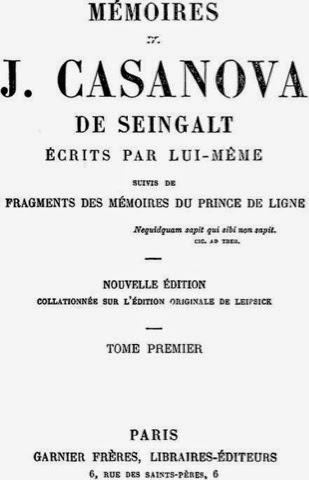
Giacomo Casanova - Memoirs


The memoirs open with:
"I begin by declaring to my reader that, by everything good or bad that I have done throughout my life, I am sure that I have earned merit or incurred guilt, and that hence I must consider myself a free agent. ... Despite an excellent moral foundation, the inevitable fruit of the divine principles which were rooted in my heart, I was all my life the victim of my senses; I have delighted in going astray and I have constantly lived in error, with no other consolation than that of knowing I have erred. ... My follies are the follies of youth. You will see that I laugh at them, and if you are kind you will laugh at them with me."

Giacomo Girolamo Casanova (2 April 1725 – 4 June 1798) was an Italian adventurer and author from the Republic of Venice. His autobiography, Histoire de ma vie (Story of My Life), is regarded as one of the most authentic sources of the customs and norms of European social life during the 18th century.
As was not uncommon at the time, Casanova often used pseudonyms, the most frequent being Chevalier de Seingalt (pronounced Saint-Galle as in French). He also published abundantly in French under the name Jacques Casanova de Seingalt.
He has become so famous for his often complicated and elaborate affairs with women that his name is now synonymous with "womanizer". He associated with European royalty, popes and cardinals, along with luminaries such as Voltaire, Goethe and Mozart. He spent his last years in Bohemia as a librarian in Count Waldstein's household, where he also wrote the story of his life.

The main authority for Casanova's life is his Mémoires (12 vols., Leipzig, 1826-38), which were written at Dux. They are clever, well written and, above all, cynical, and interesting as a trustworthy picture of the morals and manners of the times. Among Casanova's other works may be mentioned Confutazione della storia del governo Veneto d'Amelot de la Houssaye (Amsterdam, 1769), an attempt to ingratiate himself with the Venetian government; and the Histoire of his escape from prison (Leipzig, 1788).

Book english (complete)
Here 
Here 
Here 

Book spanish


Saturday, June 8, 2013

Medieval Spain 5 - Codex Calixtinus


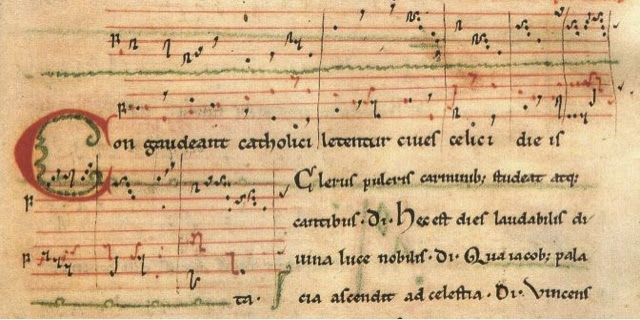
The Codex Calixtinus is a 12th-century illuminated manuscript formerly attributed to Pope Callixtus II, though now believed to have been arranged by the French scholar Aymeric Picaud. The principal author is actually given as 'Scriptor I'.
It was intended as an anthology of background detail and advice for pilgrims following the Way of St. James to the shrine of the apostle Saint James the Great, located in the cathedral of Santiago de Compostela, Galicia (Spain). The codex is alternatively known as the Liber Sancti Jacobi, or the Book of Saint James. The collection includes sermons, reports of miracles and liturgical texts associated with Saint James, and a most interesting set of polyphonic musical pìeces. In it are also found descriptions of the route, works of art to be seen along the way, and the customs of the local people.
The book was stolen from its security case in the cathedral's archives on 3 July 2011 and retrieved almost exactly a year later on 4 July 2012.

The Codex Calixtinus was intended to be chanted aloud and is of great interest to musicologists as an early example of polyphony. In particular, it contains the first known composition for three voices, the conductus Congaudeant catholici (Let all Catholics rejoice together); however, the extreme dissonance encountered when performing all three voices together has led some scholars to suggest that this was not the original intention. The popularity of the music has continued to the present day with modern recordings commercially available.


Congaudeant Catholici

O Adiutor Seculorum
Coro de Monjes del Monasterio de Santo Domingo de Silos (1969)

Ad Vesperas Sancti Iacobi
Ensemble Organum. Dir, Marcel Pérès


Thursday, May 30, 2013

Bach - Sonatas and Partitas for Solo Violin, Manuscript


Julian Shuckburgh’s new biography of J.S. Bach includes images by Caroline Wilkinson, a ‘forensic facial-reconstructor’. Wilkinson used laser scans of the Haussmann portrait and a bronze cast of Bach’s skull to build computer models of the composer’s head.

Upon Bach's death in 1750, the original manuscript passed into the possession, possibly through his second wife Anna Magdalena, of Johann Christoph Friedrich Bach. It was inherited by the last male descendant of J.C.F. Bach, Wilhelm Friedrich Ernst Bach, who passed it on to his sister Louisa of Bückeburg.
Two other early manuscripts also exist. One, originally identified as an authentic Bach autograph from his Leipzig period, is now identified as being a 1726 copy by Bach's second wife Anna Magdalena Bach, and is the companion to the earliest surviving handwritten copy of the six suites Bach wrote for solo cello. The other, a copy made by one of Bach's students Johann Peter Kellner, is well preserved, despite the fact that the B minor Partita was missing from the set and that there are numerous errors and omissions. All three manuscripts are in the Berlin State Museum and have been in the possession of the Bach-Gesellschaft since 1879, through the efforts of Alfred Dörffel.


About the work

Manuscript

Wednesday, May 29, 2013

Heraclitus "The Obscure" - Fragments


This is what's left of the work of Heraclitus, the most interesting and enigmatic of the pre-Socratic philosophers. Diversity and constant mutation; the contraries which are reconciled in the final and total unity of Logos. Heraclitus tells us that the Universe is in permanent, constant transformation, that this perennial movement is embedded in the One, the summing up of all things which constitutes only one concept (Logos). The opposite of Parmenides, who emphasized Unity over Diversity and transformation, Heraclitus is proof that, by his time (6th century BC), educated Greeks took mythology basically as literature and folklore, but not as serious religion: their minds had expanded well beyond the fantastic adventures of the many antropomorphic Gods, to devise and understand that the Divinity has to be the final Unity, whatever its form. Heraclitus is, surprisingly, extremely "modern" in his approach to Nature and Divinity. The fragments reveal a powerful intellect, a real and relevant precursor of Western culture and civilization. Recommendable both to professional philosophers (whatever that means) and to the public interested in reflecting about the Universe and what it is. (Guillermo Maynez)

Heraclitus of Ephesus (c. 535 – c. 475 BCE) was a pre-Socratic Greek philosopher, a native of the Greek city Ephesus, Ionia, on the coast of Asia Minor. He was of distinguished parentage. Little is known about his early life and education, but he regarded himself as self-taught and a pioneer of wisdom. From the lonely life he led, and still more from the riddling nature of his philosophy and his contempt for humankind in general, he was called "The Obscure" and the "Weeping Philosopher".
Heraclitus is famous for his insistence on ever-present change in the universe, as stated in the famous saying, "No man ever steps in the same river twice". He believed in the unity of opposites, stating that "the path up and down are one and the same", all existing entities being characterized by pairs of contrary properties. His cryptic utterance that "all entities come to be in accordance with this Logos" (literally, "word", "reason", or "account") has been the subject of numerous interpretations.

About Heraclitus

Book

Tuesday, May 28, 2013

Chateaubriand - Mémoires d'Outre-Tombe


Chateaubriand was the son of a Count, a fervent royalist, who died in 1786. In 1791, he spent six months in America, visiting Baltimore, Philadelphia, New York, Boston, the Mississippi, and, like almost all first-time visitors, Niagara Falls. He returned to France when he heard of the arrest of the King. Between 1792 and 1800, he lived, in exile, in Belgium, Germany, and England. In 1799, he begins a monumental work called Le génie du Christianisme [The Genius of Christianity]. The short novel, René, was written to illustrate the chapter on passions.

The sources of René are partly autobiographical (Chateaubriand’s family estate near Saint-Malo, his close relationship with his sister Lucile, social upheaval following the French Revolution, his trip to the New World), partly literary (Rousseau’s Saint-Preux, Goethe’s Werther, 18th century interest in the monastic theme as well as incest).


In 1837, in his Mémoires d’outre-tombe [Memoirs from Beyond the Grave], Chateaubriand writes: «If René did not exist, I would no longer write it; if it were possible to destroy it, I would; it has infested the souls of many youths, an effect which I had not foreseen, for it was this very malady I wished to counter. A family of poets and prose writers has come forth, and one reads only disjointed and melancholy phrases. […] There isn’t an aspiring poet who hasn’t dreamt of becoming the most miserable of men, or a youth of sixteen who, tormented by what he takes for genius, doesn’t feel that his life is over.


About Chateaubriand...

About Book...

Saturday, May 18, 2013

Medieval Spain 4 - Cantigas de Alfonso X el Sabio


The Cantigas de Santa Maria ("Canticles of Holy Mary") are 420 poems with musical notation, written in Galician-Portuguese during the reign of Alfonso X El Sabio (1221–1284) and often attributed to him. It is one of the largest collections of monophonic (solo) songs from the Middle Ages and is characterized by the mention of the Virgin Mary in every song, while every tenth song is a hymn.
The manuscripts have survived in four codices: two at El Escorial, one at Madrid's National Library, and one in Florence, Italy. Some have colored miniatures showing pairs of musicians playing a wide variety of instruments.
The music is written in notation which is similar to that used for chant, but also contains some information about the length of the notes. Several transcriptions exist. The Cantigas are frequently recorded and performed by Early Music groups, and quite a few CDs featuring music from the Cantigas are available.


Cantiga 122, miragres muitos pelos reis faz, de Alfonso X por el grupo SEMA, dirigido por Pepe Rey

About...

Book


Friday, May 17, 2013

Morocco - Paul Bowles and Mohamed Choukri

PAUL BOWLES


Paul Bowles lived for 52 of his 88 years in Tangier. Not surprisingly, he became identified with the city: during his life visitors would seek him out, and on his death obituary-writers without fail linked his life to his residency: he became a symbolic American expatriate, and the city became the symbol of his expatriate status.
At the time of his first visit with Aaron Copland in 1931 Tangier had an anomalous status, a Moroccan city which was not Moroccan, with a population at once Berber, Arab, Spanish, and European, speaking Spanish, French, Berber and Arabic, under the control of a consortium of foreign powers, one of them the United States. Paul Bowles was entranced. On his return in 1947 the city had already changed, but not enough to rob it of its aura of strangeness and wonder. In 1955 there were anti-European riots, and in 1956 the city was returned to full Moroccan control.


Paul Bowles' reputation as a composer was ultimately overshadowed by his writing. He studied with Aaron Copland. He wrote chamber music and incidental music for the stage. The score of his 1955 opera Yerma is especially memorable and gets much radio-play. He collected Moroccan folk music. His compositions are being re-released.


Book (The Sheltering Sky)


MOHAMED CHOUKRI


Choukri was born in 1935, in a small village in the Rif mountains, in the Nador province. He was raised in a very poor family. He ran away from his tyrannical father and became a homeless child living in the poor neighborhoods of Tangier, surrounded by misery, prostitution, violence and drug abuse. At the age of 20, he decided to learn how to read and write and became later a schoolteacher. In the 1960s, in the cosmopolitan Tangier, he met Paul Bowles, Jean Genet and Tennessee Williams.
For Bread Alone became an international success when was published in English translation of Al-khoubz Al-Hafi (For Bread Alone, Telegram Books) by Paul Bowles in 1973, but the book also caused a furor in the Arab world. When the Arabic edition emerged, it was prohibited in Morocco, on the authority of the Interior Minister, following the advice of the religious authorities. It was said to have offended by its references to teenage sexual experiences and drug abuse. This censorship ended in 2000, and For Bread Alone was finally published in Morocco. In 2005, For Bread Alone was removed from the syllabus of a modern Arabic Literature course at the American University in Cairo in 2005, due to some sexually explicit passages, prompting some observers to criticize the "ban" and blame government censorship.


About "For Bread Alone"...
English and Here
Spanish and Here