Showing posts with label Documentary. Show all posts

Friday, July 5, 2013

Monteverdi - L'Orfeo, favola in musica (1607)


L'Orfeo, favola in musica, is a late Renaissance/early Baroque opera by Claudio Monteverdi, with a libretto by Alessandro Striggio. It is based on the Greek legend of Orpheus, and tells the story of his descent to Hades and his fruitless attempt to bring his dead bride Eurydice back to the living world. Written in 1607 for a court performance during the annual Carnival at Mantua, L'Orfeo is one of the earliest music dramas still regularly performed.


L' ORFEO: Favola in Musica (1607) - Claudio Monteverdi (1567 - 1643). (Representación de Jordi Savall y La Capella Reial de Catalunya en el Gran Teatro del Liceo de Barcelona, 2002)


Tuesday, July 2, 2013

Stravinsky - Rite Of Spring 100 years


Stravinsky Documentary Stokowski in 'Accidental Stereo' (1929) - Stravinsky's 'Rite of Spring'. Philadelphia Orchestra


Tuesday, June 25, 2013

Mexico - María Sabina


On June 29, 1955, R. Gordon Wasson, then a vice president of the prestigious banking firm J.P. Morgan, together with his friend, New York fashion photographer Allan Richardson, made history by becoming the first whites to participate in a velada. The nocturnal mushroom ceremony took place in the remote village of Huautla de Jimenez, in the northeast region of Oaxaca, Mexico.
Under the guidance of the now famous Mazatec curandera Maria Sabina, Wasson and Richardson each consumed six pairs of the mushroom Psilocybe caerulescens var. mazatecorum. After an hour the two men began to feel the effects, which were manifest by visions of colorful geometric patterns, palaces, and architectural vistas.

Life magazine, as part of its "Great Adventures Series," published in its May 13th 1957 issue an account of this event titled, "Seeking the Magic Mushroom." This article, which inspired Dr. Timothy Leary and countless others to try the mushrooms, is considered by many to be the instrument that ushered in the "Psychedelic Revolution" of the 1960s.

Huautla de Jimenez would later become inundated with hippies hoping to "trip" with Maria Sabina. John Lennon, Peter Townshend, Mick Jagger, and Bob Dylan are some of the celebrities who traveled to Huautla, seeking the spiritual guidance of Maria Sabina. Although the Life article made Maria famous, it also brought her great suffering. Sadly, her home would later be burned and she was banished to the outskirts of town as punishment for divulging the Indians' age-old secret about their use of teonanacatl, or "God's Flesh." She never regretted having met Wasson, however, and felt that it was destiny.

She passed away on November 22nd 1985, and is now a legend in Mexico.


Wednesday, June 12, 2013

Life of Chopin, by Franz Liszt


To a people, always prompt in its recognition of genius, and ready to sympathize in the joys and woes of a truly great artist, this work will be one of exceeding interest. It is a short, glowing, and generous sketch, from the hand of Franz Liszt, (who, considered in the double light of composer and performer, has no living equal,) of the original and romantic Chopin; the most ethereal, subtle, and delicate among our modern tone-poets.

Book english
Here 
Here 

Book spanish
Here 


Chopin Documentary - The Women Behind The Music


Saturday, May 25, 2013

John Zorn: Patton, Uri Caine And A Film


John Zorn: "All the various styles are organically connected to one another. I'm an additive person - the entire storehouse of my knowledge informs everything I do. People are so obsessed with the surface that they can't see the connections, but they are there."

Mikel Patton sings Litany IV, from Six Litanies for Heliogabalus


Documentary: A Bookshelf On Top of the Sky: 12 Stories About John Zorn


Monday, May 20, 2013

Nanook Of The North (1922)


Robert Flaherty’s classic film tells the story of Inuit hunter Nanook and his family as they struggle to survive in the harsh conditions of Canada’s Hudson Bay region. Enormously popular when released in 1922, Nanook of the North is a cinematic milestone that continues to enchant audiences. The original director’s cut is restored to the proper frame rate and tinted according to Flaherty’s personal print.
Nanook of the North was the first of Robert J. Flaherty's romantic depictions of man's dignified perseverance in combating a malevolent nature. Flaherty is often called "the father of the documentary", and he did make the first theatrical documentary feature with Nanook. But that fact does not do justice to the humanism and the technical brilliance that makes his best works -- Nanook, Man of Aran andLouisiana Story -- beautiful and enduring.


Friday, May 17, 2013

Morocco - Paul Bowles and Mohamed Choukri

PAUL BOWLES


Paul Bowles lived for 52 of his 88 years in Tangier. Not surprisingly, he became identified with the city: during his life visitors would seek him out, and on his death obituary-writers without fail linked his life to his residency: he became a symbolic American expatriate, and the city became the symbol of his expatriate status.
At the time of his first visit with Aaron Copland in 1931 Tangier had an anomalous status, a Moroccan city which was not Moroccan, with a population at once Berber, Arab, Spanish, and European, speaking Spanish, French, Berber and Arabic, under the control of a consortium of foreign powers, one of them the United States. Paul Bowles was entranced. On his return in 1947 the city had already changed, but not enough to rob it of its aura of strangeness and wonder. In 1955 there were anti-European riots, and in 1956 the city was returned to full Moroccan control.


Paul Bowles' reputation as a composer was ultimately overshadowed by his writing. He studied with Aaron Copland. He wrote chamber music and incidental music for the stage. The score of his 1955 opera Yerma is especially memorable and gets much radio-play. He collected Moroccan folk music. His compositions are being re-released.


Book (The Sheltering Sky)


MOHAMED CHOUKRI


Choukri was born in 1935, in a small village in the Rif mountains, in the Nador province. He was raised in a very poor family. He ran away from his tyrannical father and became a homeless child living in the poor neighborhoods of Tangier, surrounded by misery, prostitution, violence and drug abuse. At the age of 20, he decided to learn how to read and write and became later a schoolteacher. In the 1960s, in the cosmopolitan Tangier, he met Paul Bowles, Jean Genet and Tennessee Williams.
For Bread Alone became an international success when was published in English translation of Al-khoubz Al-Hafi (For Bread Alone, Telegram Books) by Paul Bowles in 1973, but the book also caused a furor in the Arab world. When the Arabic edition emerged, it was prohibited in Morocco, on the authority of the Interior Minister, following the advice of the religious authorities. It was said to have offended by its references to teenage sexual experiences and drug abuse. This censorship ended in 2000, and For Bread Alone was finally published in Morocco. In 2005, For Bread Alone was removed from the syllabus of a modern Arabic Literature course at the American University in Cairo in 2005, due to some sexually explicit passages, prompting some observers to criticize the "ban" and blame government censorship.


About "For Bread Alone"...
English and Here
Spanish and Here


Monday, May 13, 2013

Bukowski - Born Into This (2003)


Charles Bukowski was a prolific underground writer who used his his poetry and prose to depict the depravity of urban life and the downtrodden in American society. A cult hero, Bukowski relied on experience, emotion, and imagination in his work, using direct language and violent and sexual imagery. While some critics found his style offensive, others claimed that Bukowski satirized the machismo attitude through his routine use of sex, alcohol abuse, and violence. “Without trying to make himself look good, much less heroic, Bukowski writes with a nothing-to-lose truthfulness which sets him apart from most other ‘autobiographical’ novelists and poets,” commented Stephen Kessler in the San Francisco Review of Books, adding: “Firmly in the American tradition of the maverick, Bukowski writes with no apologies from the frayed edge of society.” Michael Lally in Village Voice maintained that “Bukowski is…a phenomenon. He has established himself as a writer with a consistent and insistent style based on what he projects as his ‘personality,’ the result of hard, intense living.” 

Born in Germany, Bukowski was brought to the United States at the age of two. His father believed in firm discipline and often beat Bukowski for the smallest offenses, abuse Bukowski detailed in his autobiographical coming-of-age novel, Ham on Rye (1982). A slight child, Bukowski was also bullied by boys his own age, and was frequently rejected by girls because of his bad complexion. “When Bukowski was 13,” wrote Ciotti, “one of [his friends] invited him to his father’s wine cellar and served him his first drink of alcohol: ‘It was magic,’ Bukowski would later write. ‘Why hadn’t someone told me?’” 


About... 

Poesía en español


Monday, April 29, 2013

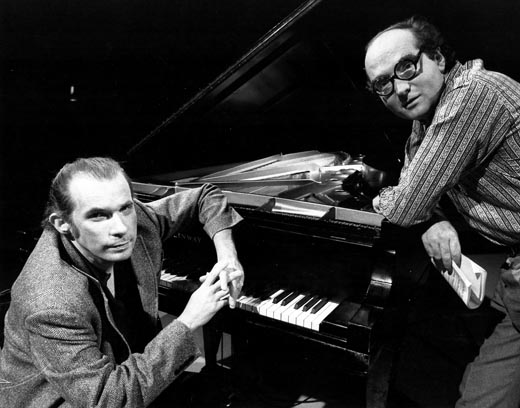
Glenn Gould, The Alchemist


Glenn GouldThe Alchemist. Bruno Monsaingeon (1974) - YouTube


Everything about Glenn Gould is full of meaning since he gives meaning to everything. In this film “The Alchemist”, we see him in several recording sessions in Toronto in 1974. At that time, for European connoisseurs the pianist, who lives in Toronto, is nothing but a distant legend. He stopped playing in concert at thirty-two, ten years previously, and his records are unobtainable in France. Monsaingeon, discovers him in 1966 when he buys a record in Moscow on which is written “Bach Inventions” and the name of the pianist which sounds vaguely familiar to him. It’s a revelation!

The Alchemist, the second part of Monsaingeon’s film, shows Glenn Gould hard at work recording; sparkling with intelligence and with an acute sense of self-mockery, he talks about his relations with the studio and his rejection of the concert, he evokes his fondness for technique which leads him to editing his own records. He does this while juggling between his piano, the editing and mixing tables and even between microphones.
“Recording is the only way I can play music for the public”. (Glenn Gould)


About...


Monday, April 22, 2013

Let's Get Lost - The Turbulent Life Of Chet Baker


Let's Get Lost (1988) is an American documentary film about the turbulent life and career of jazz trumpeter Chet Baker written and directed by Bruce Weber.