Showing posts with label Medieval Spain. Show all posts

Monday, June 24, 2013

Medieval Spain 7 - The Mistery Play of Elche


The mystery play of Elche is a sacred musical drama of the death, the passage into heaven (known as the Assumption) and the crowning of the Virgin Mary. Since the mid-fifteenth century it has been performed in the Basilica of Santa Maria and in the streets of the old city of Elche, situated in the region of Valencia. It is a living testimony of European religious theatre of the Middle Ages and of the cult of the Virgin.
This theatrical performance, which is entirely sung, comprises two acts, performed on 14 and 15 August. These depict the death and crowning of the Virgin in a series of scenes and related paintings: the death of Mary, the night procession that is followed by hundreds of participants carrying candles, the morning procession, the afternoon funeral procession in the streets of Elche, and the enactment of the burial, Assumption and coronation in the Basilica. The texts are in Valencian, the local form of Catalan, with certain sections in Latin.The stage has two levels: the horizontal “terrestrial” stage and the vertical “celestial” stage, characteristic of the medieval mystery play. Ancient aerial machinery is used to enhance the spectacle by means of special effects.
More than 300 volunteers take part in the performance each year as actors, singers, stage directors, stagehands, tailors and stewards, as well as in the preparations that last throughout the year.This tradition, which attracts the entire population of the town, is closely linked to the cultural and linguistic identity of the inhabitants of the region.The mystery play of Elche was designated a “National Monument” in 1931 and is protected by several laws aimed at safeguarding cultural heritage.


Thursday, June 20, 2013

Medieval Spain 6 - Martin Codax, Cantigas de Amigo


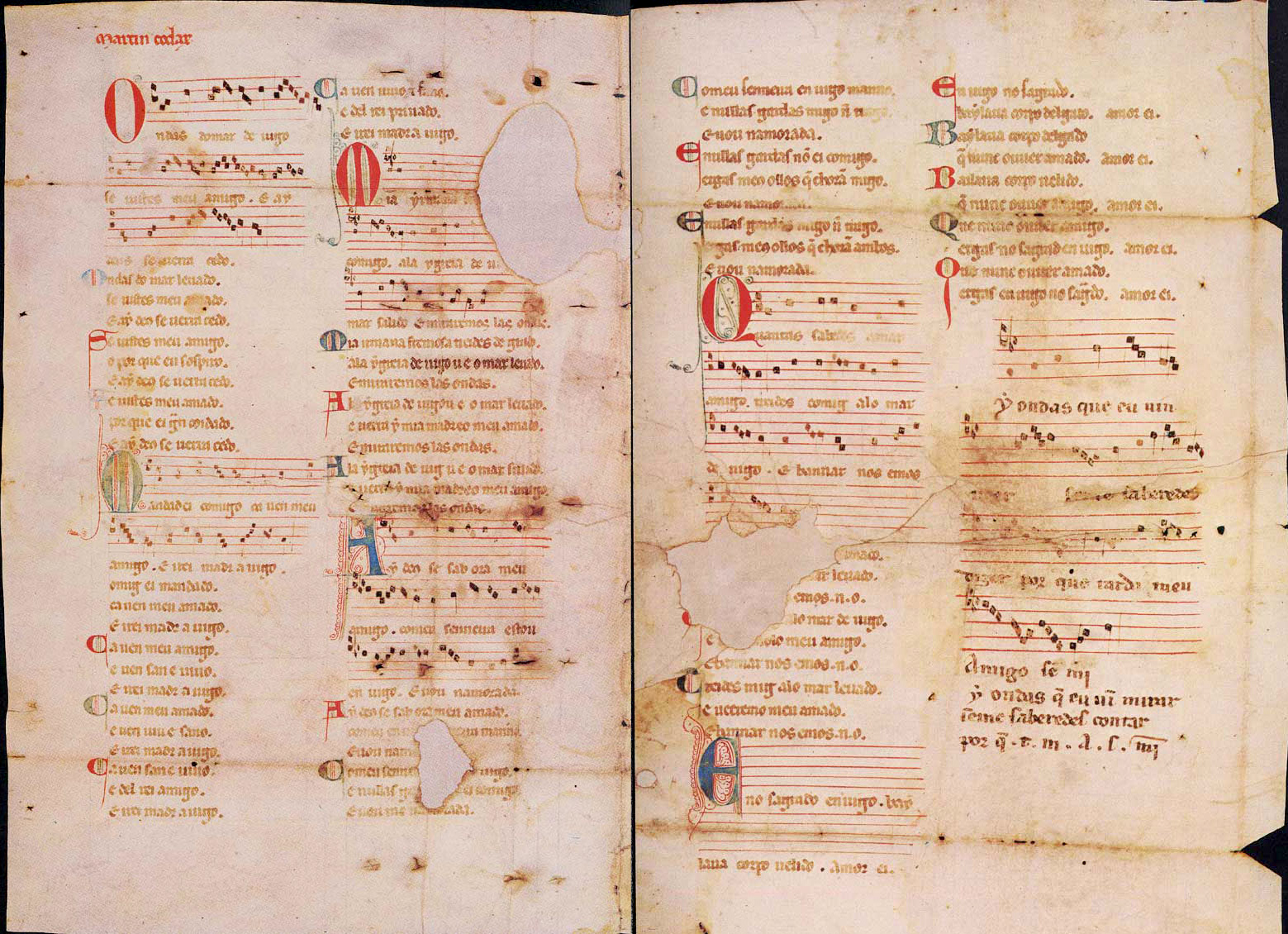
Martín Codax was a Galician medieval joglar (non-noble composer and performer—as opposed to a trobador), possibly from Vigo, Galicia, Spain. He may have been active during the middle of the thirteenth century, judging from scriptological analysis (Monteagudo 2008). He is one of only two out of a total of 88 authors of cantigas d'amigo who uses only the archaic strophic form aaB (a rhymed distich followed by a refrain). And he also employs an archaic rhyme-system whereby i~o / a~o are used in alternating strophes. His dates, however, remain unknown and there is no documentary biographical information concerning the poet.

The body of work attributed to him consists of seven cantigas d'amigo which appear in the Galician-Portuguese songbooks and in the Vindel parchment. In all three manuscripts he is listed as the author of the compositions, and in all three the number and the order of the songs is the same. This provides important evidence to support the view that the order of other poets' songs in the cancioneiros (songbooks) should not automatically be dismissed as random or attributed to later compilers. Rather, the identity of the poems and their order in all witnesses supports the view that the seven songs of Codax reflect an original performance set, and that the sets of poems by some other poets might also have been organized for performance.

This parchment was discovered by chance: the antiquarian bookseller and bibliophile Pedro Vindel in Madrid found it among his holdings in 1913; it had been used as the cover of a copy of Cicero's De Officiis.

Martim Codax's poems that appeared in the parchment are the following (untitled, they are listed by their first verse):

Ondas do mar de Vigo
Mandad'ey comigo
Mia irmana fremosa treydes comigo
Ay Deus, se sab'ora meu amigo
Quantas sabedes amar amigo
Eno sagrad' en Vigo
Ay ondas que eu vin veer

In the Vindel parchment musical notation (although with lacunae) survives along with the texts, except for the sixth one. They are the only cantiga de amigo for which the music is known (and, if Codax was indeed Galician, the only medieval Galician secular songs (see Cantigas de Santa Maria). The Pergaminho Sharrer contains seven melodies for cantiga de amor of Denis of Portugal, also in fragmentary form.


Martín Códax (c.1230): Cantigas de Amigo - Ensemble Triphonia


Saturday, June 8, 2013

Medieval Spain 5 - Codex Calixtinus


The Codex Calixtinus is a 12th-century illuminated manuscript formerly attributed to Pope Callixtus II, though now believed to have been arranged by the French scholar Aymeric Picaud. The principal author is actually given as 'Scriptor I'.
It was intended as an anthology of background detail and advice for pilgrims following the Way of St. James to the shrine of the apostle Saint James the Great, located in the cathedral of Santiago de Compostela, Galicia (Spain). The codex is alternatively known as the Liber Sancti Jacobi, or the Book of Saint James. The collection includes sermons, reports of miracles and liturgical texts associated with Saint James, and a most interesting set of polyphonic musical pìeces. In it are also found descriptions of the route, works of art to be seen along the way, and the customs of the local people.
The book was stolen from its security case in the cathedral's archives on 3 July 2011 and retrieved almost exactly a year later on 4 July 2012.

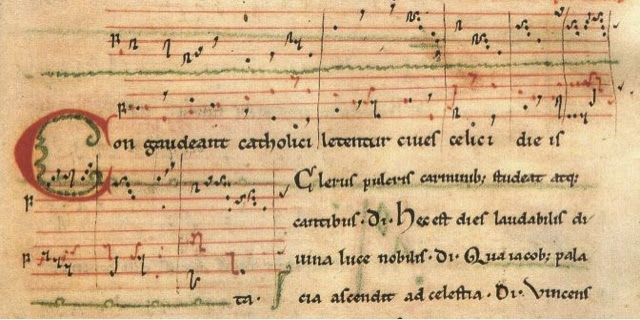
The Codex Calixtinus was intended to be chanted aloud and is of great interest to musicologists as an early example of polyphony. In particular, it contains the first known composition for three voices, the conductus Congaudeant catholici (Let all Catholics rejoice together); however, the extreme dissonance encountered when performing all three voices together has led some scholars to suggest that this was not the original intention. The popularity of the music has continued to the present day with modern recordings commercially available.


Congaudeant Catholici

O Adiutor Seculorum
Coro de Monjes del Monasterio de Santo Domingo de Silos (1969)

Ad Vesperas Sancti Iacobi
Ensemble Organum. Dir, Marcel Pérès


Saturday, May 18, 2013

Medieval Spain 4 - Cantigas de Alfonso X el Sabio


The Cantigas de Santa Maria ("Canticles of Holy Mary") are 420 poems with musical notation, written in Galician-Portuguese during the reign of Alfonso X El Sabio (1221–1284) and often attributed to him. It is one of the largest collections of monophonic (solo) songs from the Middle Ages and is characterized by the mention of the Virgin Mary in every song, while every tenth song is a hymn.
The manuscripts have survived in four codices: two at El Escorial, one at Madrid's National Library, and one in Florence, Italy. Some have colored miniatures showing pairs of musicians playing a wide variety of instruments.
The music is written in notation which is similar to that used for chant, but also contains some information about the length of the notes. Several transcriptions exist. The Cantigas are frequently recorded and performed by Early Music groups, and quite a few CDs featuring music from the Cantigas are available.


Cantiga 122, miragres muitos pelos reis faz, de Alfonso X por el grupo SEMA, dirigido por Pepe Rey

About...

Book


Tuesday, May 7, 2013

Medieval Spain 3 - Cantar de Mío Cid


The anonymous Cantar de mio Cid is the great epic of medieval Spain. It is one of the oldest Spanish historical documents in existence, and the only Spanish cantar de geste (song of heroic deeds) to have survived almost completely intact. The 3,730-line poem chronicles the exploits of the Cid (from the Arabic sayyid, which means “master”), or Rodrigo (Ruy) Díaz de Vivar, a commander under King Alfonso VI of Castile, who wins back his King's favor by taking back southern Spain from its Islamic occupiers. Like many literary works of the Middle Ages, the Cid is based on an historical figure, but much of this story is fictionalized in order to offer an idealized portrait of the main character and emphasize his valor and loyalty. The poem interweaves irony, heroic drama, and realism to present colorful portraits of Moors, Jews, and Christians, providing modern readers with a unique glimpse into medieval Spain. Over the centuries, numerous editions and translations of the Cid have appeared, attesting to the work's popularity. 

Book


About...


Wednesday, April 24, 2013

Medieval Spain 2 - Codex Las Huelgas


The Codex Las Huelgas or Codex Musical de Las Huelgas (E-BUlh) is a music manuscript or codex from c. 1300 which originated in and has remained in the Cistercian convent of Santa María La Real de Las Huelgas in Burgos, in northwestern Spain, then Castile. It was rediscovered in 1904 by two Benedictine monks. The manuscript is written on parchment, with the staves written in red ink with Franconian notation. The bulk of material is written in one hand, however as many as 12 people contributed to it, including corrections and later additions. The manuscript contains 45 monophonic pieces (20 sequences, 5 conductus, 10 Benedicamus tropes) and 141 polyphonic compositions, 1 of which doesn't have music. Most of the music dates from the late 13th century, with some music from the first half of the 13th century (Notre Dame repertory), and a few later additions from the first quarter of the 14th century.Johannes Roderici (Johan Rodrigues) inscribed his name in a number of places in the manuscript. He may have composed a couple of the pieces in the manuscript, as well as being scribe, compiler, and corrector, according to his own inscriptions.


Friday, April 19, 2013

Medieval Spain 1 - Mozarabic Antiphonary of Leon


The manuscript was copied by Totmundo Abbot in the year 1069, in the leonine monastery of San Cipriano of the County and was dedicated it to Ikila Abbot, who got to be bishop of Leon. In a note in folio 25, one says that in the year was directly copied of another manuscript of the time of the king Wamba 672 . At the moment Cathedral of Leon is in .

The manuscript begins, like is habitual in many Spanish codices of the high average age, with a Cross of Oviedo (in memory, according to the legend, of that it appeared to him to king Pelayo in the battle of Covadonga) and a miniature in which it is seen the cotrack, Totmundo, giving the finished book once, to Ikila Abbot. Totmundo takes on the head the pronoun ille in humility signal. This representation of the delivery of the finished work was also very frequent in the first incunables.

The book contains sung antiphons in the celebrations of the liturgical cycle and the saints. Mozarabic Antiphonary is unique that has arrived to us complete. Of other Mozarabic antiphonaries, like both of Silos, the one of San Juan of the Rock or the one of San Zoilo de Carrión has only conserved small fragments.

The antiphonary presents/displays the musical annotation in Neumas without pentagrama, in visigótica Annotation, and it could not have been deciphered until the moment, in spite of the efforts realized by the musicologists. It contains many illustrations, especially scenes of the life of Jesus. Some letters own interlaces that remember but to the art carolingio that to the visigótico.


Antiphonary of Leon Codex Manuscript