Sunday, June 23, 2013

Balzac - The Unknown Masterpiece


In 1927, Picasso's dealer Ambroise Vollard commissioned the artist to illustrate a special re-edition of Balzac's 1837 short story, "The Unknown Masterpiece".
Balzac's story is set in the Seventeenth century at a studio in the rue des Grandes-Augustins in Paris. It unfolds around an aging artist called Frenhofer, who is the greatest painter of his day. Frenhofer reveals to two of his ardent admirers, Pourbus and Poussin, that he has been working on a secret painting which has for years consumed all his creative powers. Pourbus and Poussin then scheme to get Frenhofer to show them the painting by procuring a beautiful young model for its completion. When they finally see the Unknown Masterpiece it appears to be nothing but a mess of lines and layers of paint which they immediately interpret as being the work of a raving madman.

Picasso identified with Frenhofer and was fascinated by Balzac's eerie story. In the 1930's, as if by a strange twist of fate, he rented Nº 7 rue des Grandes-Augustin, which he and others believed to be the the house in which the story begins. It was at this address in 1937, exactly one hundred years after Balzac's final version, that Picasso painted his most famous masterpiece - Guernica.

Picasso later claimed to have been haunted by Balzac; and there seem to be strange parallels between Frenhofer's Unknown Masterpiece and the 1934 drawing. As with Frenhofer's painting, the drawing seems to be the product of an extraordinary creative process. Its existence also appears to have been kept a closely guarded secret. Similarly, at first encounter, the drawing appears to be a mess of lines and smudged inks, yet what it contains is probably the most complete convergence of themes in the entire range of Picasso's work. For these reasons, it seems that the drawing was probably intended to be Picasso's version of the Unknown Masterpiece. © Mark Harris 1996

English formats
Pdf 

Book spanish pdf
Here and Here

Book French
Here 


Based on Honore de Balzac's "Le chef-d'oeuvre inconnu" (or The Unknown masterpiece), La Belle Noiseuse is a 1991 film directed by Jacques Rivette and starring Michel Piccoli as the distressed artist, obsessed with something that will never exist: The perfect and flawless artistic masterpiece.


Saturday, June 22, 2013

Thomas Adès - Tevot


I talked to Thomas Adès, one of today's most brilliant composers (and conductors, and pianists, and programmers) to get him to explain his musical universe. Did he explain? Only up to a point. But our conversations are sketches towards an understanding; their illumination, I hope, comes from how Adès answers, parries, and sometimes obfuscates the questions I ask him. Along the way, there are insights into the music he loves and loathes, especially the operas of Janacek and Wagner, aspects of Mahler's symphonies, and Brahms's and Britten's music. He also reveals his priorities as a composer and listener: the "magnetism" he hears in every note or combination of notes he plays on the piano or puts down on manuscript paper. Follow...


Thomas Adès - Tevot   

Friday, June 21, 2013

Japan - Zen Hôyô, Liturgy of Zen Buddhism


Ocora's disc by Zen Hôyô features a monastic rite of Rinzai Zen Buddhism. Its alternation of the recitation of sûtras and prayers with instrumental sequences is done in the monk's search for sûnyatâ.

Zen aims at a perfection of personhood. To this end, sitting meditation called “za-zen” is employed as a foundational method of prāxis across the different schools of this Buddha-Way, through which the Zen practitioner attempts to embody non-discriminatory wisdom vis-à-vis the meditational experience known as “satori” (enlightenment). A process of discovering wisdom culminates in the experiential dimension in which the equality of thing-events is apprehended in discerning them. The most distinguishing feature of this school of the Buddha-Way is seen in its contention that wisdom, accompanied by compassion, is expressed in the everyday “life-world” when associating with one's self, people, and nature. The everyday “life-world” for most people is an evanescent transforming stage in which living is consumed, philosophically speaking, by an either-or, ego-logical, dualistic paradigm of thinking with its attendant psychological states such as stress and anxiety. Zen demands an overcoming of this paradigm by practically achieving an holistic perspective in cognition, so that the Zen practitioner can celebrate, with a stillness of mind, a life of tending toward the concrete thing-events of everyday life and nature. For this reason, the Zen practitioner is required to embody freedom expressive of the original human nature.


Japan - Zen Hôyô, Liturgy of Zen Buddhism
Moines du temple Daitokuji de Kyôto - Récitation du Daihishinjû
liturgie du bouddhisme zen (2010 | Ocora Radio France)

Taisen Deshimaru - Maka Hannya Haramita Shingyo


Thursday, June 20, 2013

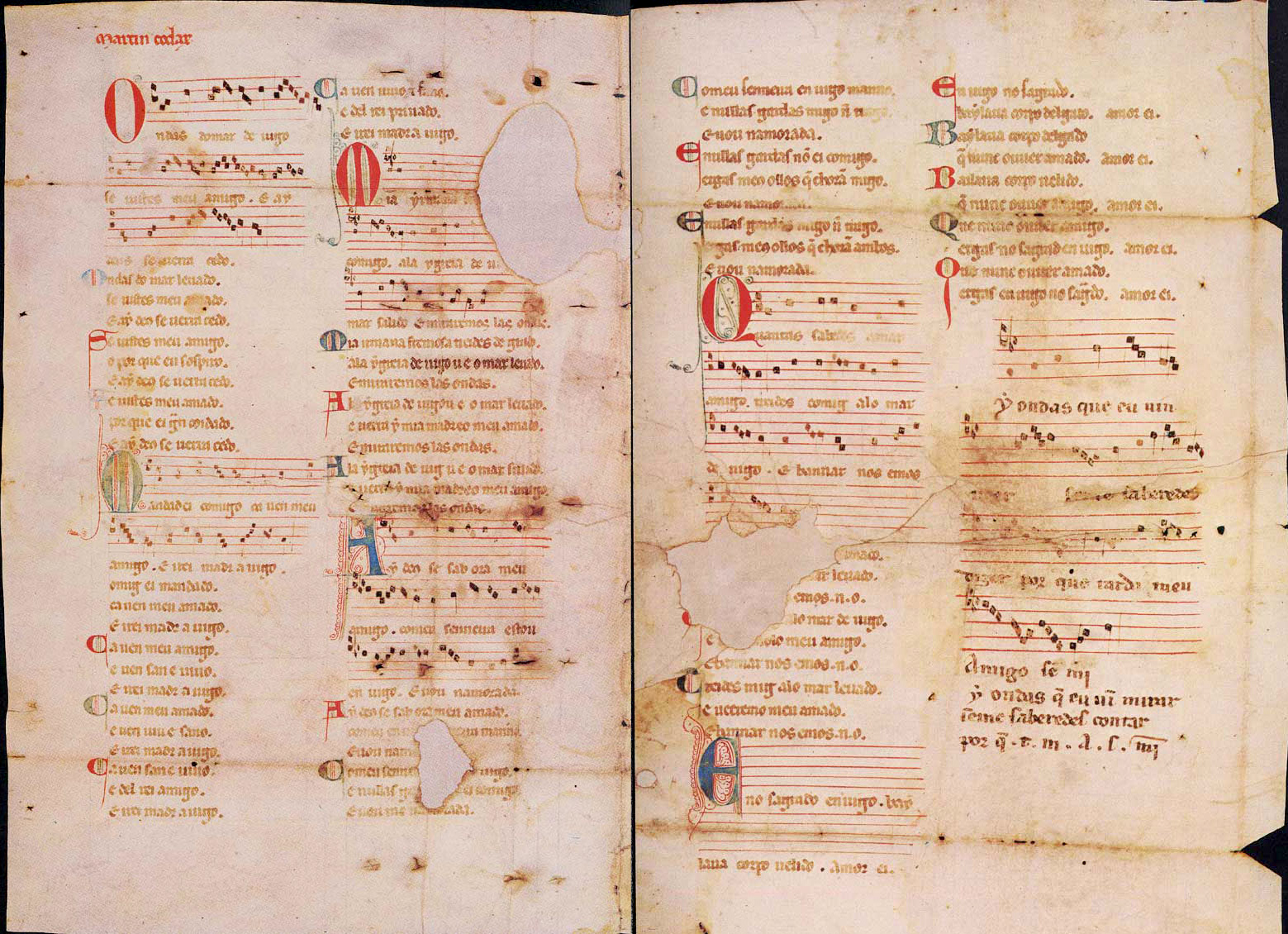
Medieval Spain 6 - Martin Codax, Cantigas de Amigo


Martín Codax was a Galician medieval joglar (non-noble composer and performer—as opposed to a trobador), possibly from Vigo, Galicia, Spain. He may have been active during the middle of the thirteenth century, judging from scriptological analysis (Monteagudo 2008). He is one of only two out of a total of 88 authors of cantigas d'amigo who uses only the archaic strophic form aaB (a rhymed distich followed by a refrain). And he also employs an archaic rhyme-system whereby i~o / a~o are used in alternating strophes. His dates, however, remain unknown and there is no documentary biographical information concerning the poet.

The body of work attributed to him consists of seven cantigas d'amigo which appear in the Galician-Portuguese songbooks and in the Vindel parchment. In all three manuscripts he is listed as the author of the compositions, and in all three the number and the order of the songs is the same. This provides important evidence to support the view that the order of other poets' songs in the cancioneiros (songbooks) should not automatically be dismissed as random or attributed to later compilers. Rather, the identity of the poems and their order in all witnesses supports the view that the seven songs of Codax reflect an original performance set, and that the sets of poems by some other poets might also have been organized for performance.

This parchment was discovered by chance: the antiquarian bookseller and bibliophile Pedro Vindel in Madrid found it among his holdings in 1913; it had been used as the cover of a copy of Cicero's De Officiis.

Martim Codax's poems that appeared in the parchment are the following (untitled, they are listed by their first verse):

Ondas do mar de Vigo
Mandad'ey comigo
Mia irmana fremosa treydes comigo
Ay Deus, se sab'ora meu amigo
Quantas sabedes amar amigo
Eno sagrad' en Vigo
Ay ondas que eu vin veer

In the Vindel parchment musical notation (although with lacunae) survives along with the texts, except for the sixth one. They are the only cantiga de amigo for which the music is known (and, if Codax was indeed Galician, the only medieval Galician secular songs (see Cantigas de Santa Maria). The Pergaminho Sharrer contains seven melodies for cantiga de amor of Denis of Portugal, also in fragmentary form.


Martín Códax (c.1230): Cantigas de Amigo - Ensemble Triphonia


Wednesday, June 19, 2013

Very Old Recordings 7: Ysaye and Rachmaninoff


Eugene Ysaye Plays Mendelssohn Concerto (mov. 3) ca.1912

Rachmaninoff plays Rachmaninoff (Welte)


Tuesday, June 18, 2013

Jardín Mecánico (Mechanical Garden) for String Quintet


Jesús Rueda - Jardín Mecánico (1999)
Arditti Quartet, Toni G. Araque, Cb
Rec. 2005 London


Monday, June 17, 2013

James Joyce - Ulysses


Joyce first encountered Odysseus in Charles Lamb's Adventures of Ulysses—an adaptation of the Odyssey for children, which seemed to establish the Roman name in Joyce's mind. At school he wrote an essay on Ulysses entitled "My Favourite Hero". Joyce told Frank Budgen that he considered Ulysses the only all-round character in literature. He thought about calling Dubliners by the name Ulysses in Dublin, but the idea grew from a story in Dubliners in 1906, to a "short book" in 1907, to the vast novel that he began in 1914.

Book english
Here 
Here 

Book spanish
Here 


Ulysses


Sunday, June 16, 2013

John Adams - Orchestral Music


One reason critic Alex Ross finds John Adams' music so appealing is that the composer doesn't shy away from emotion.

"The emotional thing is very important, I think," Ross says. "There's no caution there. There's no sort of intellectual jockeying for position. He just seems to just put it out there and not worry about the correctness of these sounds. They just kind of well up in him, and he's just not afraid to put them down on paper."

John Adams, The Chairman Dances Foxtrot per orchestra 1985
Francesco Ommassini Conductor
Orchestra Arena di Verona
Reg live 27.11.2011 Teatro Filarmonico Verona Italy

JOHN ADAMS - DOCTOR ATOMIC SYMPHONY - GSTAAD FESTIVAL ORCHESTRA - KRISTJAN JARVI - DIRECTOR - 2011


Saturday, June 15, 2013

Viet Nam - Nha Nhac Vietnamese Court Music and Traditional Music

Nhã nhạc is a form of Vietnamese court music. Vietnamese court music is very diverse, but the term nhã nhạc (雅樂, meaning "elegant music" or "ceremonial music") refers specifically to the Vietnamese court music performed from the Trần dynasty of the 13th century to the Nguyễn dynasty, which ended in the early 20th century.

Vietnamese court music was performed at annual ceremonies, including anniversaries and religious holidays, as well as special events such as coronations, funerals or official receptions, by highly trained and skilled court musicians. Along with the musicians, a number of intricate court dances also exist (see Traditional Vietnamese dance). Both musicians and dancers wore elaborately designed costumes during their performances.
While the largest foreign influence on nhã nhạc came from the Ming dynasty court of China, later on there were also adapted a few elements from the music of Champa, which the Vietnamese court found intriguing.

Instruments commonly used for nhã nhạc include kèn bầu (conical oboe), đàn tỳ bà (pear-shaped lute with four strings), đàn nguyệt (moon-shaped two-string lute), đàn tam (fretless lute with snakeskin-covered body and three strings), đàn nhị (two-stringed vertical fiddle), sáo (also called sáo trúc; a bamboo transverse flute), trống (drum played with sticks), and other percussion instruments.

It is believed that nhã nhạc did not truly reach the pinnacle of its development until the Nguyễn Dynasty, when it was synthesized. The Nguyễn emperors declared it as the official court music, and it became an essential part of the extensive rituals of the royal palace.

Nhã nhạc is still performed in the old capital of Huế. 'Nhã nhạc of Huế court' (Nhã nhạc cung đình Huế) was recognised in 2005 by UNESCO as a Masterpiece of the Oral and Intangible Heritage of Humanity. Extensive efforts have gone underway to preserve this truly unique and highly developed art. (From Wikipedia, the free encyclopedia)


Nha Nhac, Vietnamese Court Music

Musique élégante de Hue - Vietnam, Nha nhac


Vietnamese Traditional Music


Friday, June 14, 2013

Ted Hughes - Last Letter


Edward James "Ted" Hughes, OM (17 August 1930 – 28 October 1998) was an English poet and children's writer. Critics routinely rank him as one of the best poets of his generation.
Hughes was married to American poet Sylvia Plath, from 1956 until her suicide in 1963 at the age of 30. His part in the relationship became controversial to some feminists and (particularly) American admirers of Plath. His last poetic work, Birthday Letters (1998), explored their complex relationship. These poems make reference to Plath's suicide, but none of them addresses directly the circumstances of her death. A poem discovered in October 2010, Last letter, describes what happened during the three days leading up to Plath's suicide.
In 2008 The Times ranked Hughes fourth on their list of "The 50 greatest British writers since 1945".

Hughes and Plath had two children, Frieda Rebecca (1960) and Nicholas Farrar (1962) and in 1961, bought the house Court Green, in North Tawton, Devon. In the summer of 1962 Hughes began an affair with Assia Wevill who had been subletting the Primrose Hill flat with her husband. Under a cloud of his affair, Hughes and Plath separated in the autumn of 1962 and she set up life in a new flat with the children.

The death of Plath

Hughes' wife Sylvia Plath, beset by depression, and with a history of suicide attempts, took her own life on 11 February 1963, although it is unclear whether she meant to ultimately succeed. Hughes was devastated. In a letter to an old friend of Plath's from Smith College, he wrote, "That's the end of my life. The rest is posthumous." Some feminists argued that Hughes had driven Plath to suicide. Plath's gravestone was repeatedly vandalized by those aggrieved that "Hughes" is written on the stone and attempted to chisel it off, leaving only the name "Sylvia Plath." In 1970, radical feminist poet Robin Morgan published the poem "Arraignment", in which she openly accused Hughes of the battery and murder of Plath; other feminists threatened to kill him in Plath's name. In 1989, with Hughes under public attack, a battle raged in the letters pages of The Guardian and The Independent. In The Guardian on 20 April 1989 Hughes wrote the article "The Place Where Sylvia Plath Should Rest in Peace":
In the years soon after [Plath's] death, when scholars approached me, I tried to take their apparently serious concern for the truth about Sylvia Plath seriously. But I learned my lesson early... If I tried too hard to tell them exactly how something happened, in the hope of correcting some fantasy, I was quite likely to be accused of trying to suppress Free Speech. In general, my refusal to have anything to do with the Plath Fantasia has been regarded as an attempt to suppress Free Speech...The Fantasia about Sylvia Plath is more needed than the facts. Where that leaves respect for the truth of her life (and of mine), or for her memory, or for the literary tradition, I do not know.

As Plath's widower, Hughes became the executor of Plath’s personal and literary estates. He oversaw the publication of her manuscripts, including Ariel (1966). Some critics were dissatisfied by his choice of poem order and omissions in the book and some feminists argued that Hughes had essentially driven her to suicide and therefore should not be responsible for her literary legacy. He claimed to have destroyed the final volume of Plath’s journal, detailing their last few months together. In his foreword to The Journals of Sylvia Plath, he defends his actions as a consideration for the couple's young children.
On 25 March 1969, six years after Plath's suicide by asphyxiation from a gas stove, Assia Wevill committed suicide in the same way. Wevill also killed her child, Alexandra Tatiana Elise (nicknamed Shura), the four-year-old daughter of Hughes, born on 3 March 1965. Their deaths led to claims that Hughes had been abusive to both Plath and Wevill. In shock, Hughes could not finish the Crow sequence, which remained unfinished until the work Cave Birds was published in 1975. Crow, and the timing of its publication, seemed to underline Hughes's predisposition for dark violence, exemplified by the nature that he wrote about, red in tooth and claw.

Ted Hughes‘s previously unknown poem about Sylvia Plath‘s suicide has recently surfaced.
Full text of the poem after the jump.

“Last Letter”

What happened that night? Your final night.
Double, treble exposure
Over everything. Late afternoon, Friday,
My last sight of you alive.
Burning your letter to me, in the ashtray,
With that strange smile. Had I bungled your plan?
Had it surprised me sooner than you purposed?
Had I rushed it back to you too promptly?
One hour later—-you would have been gone
Where I could not have traced you.
I would have turned from your locked red door
That nobody would open
Still holding your letter,
A thunderbolt that could not earth itself.
That would have been electric shock treatment
For me.
Repeated over and over, all weekend,
As often as I read it, or thought of it.
That would have remade my brains, and my life.
The treatment that you planned needed some time.
I cannot imagine
How I would have got through that weekend.
I cannot imagine. Had you plotted it all?

Your note reached me too soon—-that same day,
Friday afternoon, posted in the morning.
The prevalent devils expedited it.
That was one more straw of ill-luck
Drawn against you by the Post-Office
And added to your load. I moved fast,
Through the snow-blue, February, London twilight.
Wept with relief when you opened the door.
A huddle of riddles in solution. Precocious tears
That failed to interpret to me, failed to divulge
Their real import. But what did you say
Over the smoking shards of that letter
So carefully annihilated, so calmly,
That let me release you, and leave you
To blow its ashes off your plan—-off the ashtray
Against which you would lean for me to read
The Doctor’s phone-number.
My escape
Had become such a hunted thing
Sleepless, hopeless, all its dreams exhausted,
Only wanting to be recaptured, only
Wanting to drop, out of its vacuum.
Two days of dangling nothing. Two days gratis.
Two days in no calendar, but stolen
From no world,
Beyond actuality, feeling, or name.

My love-life grabbed it. My numbed love-life
With its two mad needles,
Embroidering their rose, piercing and tugging
At their tapestry, their bloody tattoo
Somewhere behind my navel,
Treading that morass of emblazon,
Two mad needles, criss-crossing their stitches,
Selecting among my nerves
For their colours, refashioning me
Inside my own skin, each refashioning the other
With their self-caricatures,

Their obsessed in and out. Two women
Each with her needle.

That night
My dellarobbia Susan. I moved
With the circumspection
Of a flame in a fuse. My whole fury
Was an abandoned effort to blow up
The old globe where shadows bent over
My telltale track of ashes. I raced
From and from, face backwards, a film reversed,
Towards what? We went to Rugby St
Where you and I began.
Why did we go there? Of all places
Why did we go there? Perversity
In the artistry of our fate
Adjusted its refinements for you, for me
And for Susan. Solitaire
Played by the Minotaur of that maze
Even included Helen, in the ground-floor flat.
You had noted her—-a girl for a story.
You never met her. Few ever met her,
Except across the ears and raving mask
Of her Alsatian. You had not even glimpsed her.
You had only recoiled
When her demented animal crashed its weight
Against her door, as we slipped through the hallway;
And heard it choking on infinite German hatred.

That Sunday night she eased her door open
Its few permitted inches.
Susan greeted the black eyes, the unhappy
Overweight, lovely face, that peeped out
Across the little chain. The door closed.
We heard her consoling her jailor
Inside her cell, its kennel, where, days later,
She gassed her ferocious kapo, and herself.

Susan and I spent that night
In our wedding bed. I had not seen it
Since we lay there on our wedding day.
I did not take her back to my own bed.
It had occurred to me, your weekend over,
You might appear—-a surprise visitation.
Did you appear, to tap at my dark window?
So I stayed with Susan, hiding from you,
In our own wedding bed—-the same from which
Within three years she would be taken to die
In that same hospital where, within twelve hours,
I would find you dead.
Monday morning
I drove her to work, in the City,
Then parked my van North of Euston Road
And returned to where my telephone waited.

What happened that night, inside your hours,
Is as unknown as if it never happened.
What accumulation of your whole life,
Like effort unconscious, like birth
Pushing through the membrane of each slow second
Into the next, happened
Only as if it could not happen,
As if it was not happening. How often
Did the phone ring there in my empty room,
You hearing the ring in your receiver—-
At both ends the fading memory
Of a telephone ringing, in a brain
As if already dead. I count
How often you walked to the phone-booth
At the bottom of St George’s terrace.
You are there whenever I look, just turning
Out of Fitzroy Road, crossing over
Between the heaped up banks of dirty sugar.
In your long black coat,
With your plait coiled up at the back of your hair
You walk unable to move, or wake, and are
Already nobody walking
Walking by the railings under Primrose Hill
Towards the phone booth that can never be reached.
Before midnight. After midnight. Again.
Again. Again. And, near dawn, again.

At what position of the hands on my watch-face
Did your last attempt,
Already deeply past
My being able to hear it, shake the pillow
Of that empty bed? A last time
Lightly touch at my books, and my papers?
By the time I got there my phone was asleep.
The pillow innocent. My room slept,
Already filled with the snowlit morning light.
I lit my fire. I had got out my papers.
And I had started to write when the telephone
Jerked awake, in a jabbering alarm,
Remembering everything. It recovered in my hand.
Then a voice like a selected weapon
Or a measured injection,
Coolly delivered its four words
Deep into my ear: ‘Your wife is dead.’

and

Here 


Discovered in the British library 47 years after the death of his wife Sylvia Plath, here is Ted Hughes' "Last Letter" poem to Plath, read by Dave Stewart.


Thursday, June 13, 2013

Love Song n.3


Jesus Rueda - Love Song n.3 (from 5 Love Songs)
Ángela Rubio, cello & Clara Romero, piano


Wednesday, June 12, 2013

Life of Chopin, by Franz Liszt


To a people, always prompt in its recognition of genius, and ready to sympathize in the joys and woes of a truly great artist, this work will be one of exceeding interest. It is a short, glowing, and generous sketch, from the hand of Franz Liszt, (who, considered in the double light of composer and performer, has no living equal,) of the original and romantic Chopin; the most ethereal, subtle, and delicate among our modern tone-poets.

Book english
Here 
Here 

Book spanish
Here 


Chopin Documentary - The Women Behind The Music


Tuesday, June 11, 2013

Very Old Recordings 6 - Ravel, Saint-Saëns and Rachmaninoff


Ravel plays Ravel
Valses Nobles et Sentimentales (1913 Welte Mignon Recording)

Saint-Saens plays Saint-Saens
Valse Mignonne (Rec.1919 Welte Mignon)

Rachmaninoff plays "The Swan" by Saint-Saëns (1924)


Monday, June 10, 2013

Jean Giono - The Man Who Planted Trees


The Man Who Planted Trees (French title L'homme qui plantait des arbres), also known as The Story of Elzéard Bouffier, The Most Extraordinary Character I Ever Met, and The Man Who Planted Hope and Reaped Happiness, is an allegorical tale by French author Jean Giono, published in 1953.
It tells the story of one shepherd's long and successful singlehanded effort to re-forest a desolate valley in the foothills of the Alps in Provence throughout the first half of the 20th century. The tale is quite short—only about 4000 words long. It was composed in French, but first published in English.

The story begins in the year 1910, when this young man is undertaking a lone hiking trip through Provence, France, and into the Alps, enjoying the relatively unspoiled wilderness.
The narrator runs out of water in a treeless, desolate valley where only wild lavender grows and there is no trace of civilization except old, empty crumbling buildings. The narrator finds only a dried up well, but is saved by a middle-aged shepherd who takes him to a spring he knows of.
Curious about this man and why he has chosen such a lonely life, the narrator stays with him for a time. The shepherd, after being widowed, has decided to restore the ruined landscape of the isolated and largely abandoned valley by single-handedly cultivating a forest, tree by tree. The shepherd, Elzéard Bouffier, makes holes in the ground with his curling pole and drops into the holes acorns that he has collected from many miles away...

"L'homme qui plantait des arbes," 1987, Canada, Frederic Back, story by Jean Giono