Friday, May 10, 2013

Love Song 2


Jesus Rueda - Love Song n.2 (from Love Songs)
Ángela Rubio, cello / Clara Romero, piano


Thursday, May 9, 2013

Tuareg Music in Essakane (Timbuktu)


Traditional Tuareg music has two major components: the monochord violin anzad played often during night parties and a small tambour covered with goatskin called tende, performed during camel and horse races, and other festivities. Traditional songs called Asak and Tisiway (poems) are sung by women and men during feasts and social occasions. Another popular Tuareg musical genre is takamba, characteristic for its Afro percussions.

About...


Wednesday, May 8, 2013

Chris Marker - La Jetée (1962)


"This is the story of a man marked by an image of his childhood."


THE GROUND-BREAKING 60′S EXPERIMENTAL FILM THAT INFLUENCED “12 MONKEYS”. IN THE WAKE OF WWIII PARIS, A TEAM OF SCIENTISTS EXPERIMENT WITH TIME-TRAVEL IN ORDER TO PROVIDE HOPE FOR THEIR FUTURE.
No one can accuse Chris Marker’s classic La Jetée, of failing to receive ample exposure however. It is one of the most famous short films in history, a staple of film education curricula and recipient of a very lovely Criterion Collection release. Furthermore, its influence within sci-fi filmmaking has echoed through the decades, directly influencing prominent filmmakers like Terry Gilliam and James Cameron.
La Jetée is Marker’s most famous film, but according to the credits it was not a film at all. The filmmaker termed it an “un photo roman” or photo novel, referring to it’s unusual construction. Comprised almost entirely of still images, the film highlights the process of filmic editing through the stark precision of its images. The time-traveling tale allows for great play in elision and filmic time, which is probably why scholars are so crazy for it.

About...

Wiki
More and
More


Tuesday, May 7, 2013

Medieval Spain 3 - Cantar de Mío Cid


The anonymous Cantar de mio Cid is the great epic of medieval Spain. It is one of the oldest Spanish historical documents in existence, and the only Spanish cantar de geste (song of heroic deeds) to have survived almost completely intact. The 3,730-line poem chronicles the exploits of the Cid (from the Arabic sayyid, which means “master”), or Rodrigo (Ruy) Díaz de Vivar, a commander under King Alfonso VI of Castile, who wins back his King's favor by taking back southern Spain from its Islamic occupiers. Like many literary works of the Middle Ages, the Cid is based on an historical figure, but much of this story is fictionalized in order to offer an idealized portrait of the main character and emphasize his valor and loyalty. The poem interweaves irony, heroic drama, and realism to present colorful portraits of Moors, Jews, and Christians, providing modern readers with a unique glimpse into medieval Spain. Over the centuries, numerous editions and translations of the Cid have appeared, attesting to the work's popularity. 

Book


About...


Monday, May 6, 2013

George Sand - A Winter in Majorca


A winter in Majorca? What could be more romantic? To escape northern Europe with your lover – a famous composer – and seek solace in the mountains, vineyards and citrus groves of one of the most beautiful islands in the Mediterranean. Sadly for George Sand, her fantasy sojourn couldn't have been more disappointing in reality. Follow...


About...

Book

Jesus Rueda - Chopin (from 24 Interludes)
Ananda Sukarlan, piano


Sunday, May 5, 2013

Enjoying Life


Jesus Rueda - Enjoying Life (from Copenhagen Sketches)
Jesus Rueda, piano


Saturday, May 4, 2013

Munir Bashir - منير بشير Meditations


Munir Bashir the King Of Oud (1930-1997) was an Iraqi musician and one of the most famous musicians in the Middle East during the 20th century and was considered to be the supreme master of the Arab maqamat scale system.
He created different styles of the Arabian short scaled lute, the oud. He was one of the first middle eastern instrumentalists known to Europe and America. Bashir’s music is distinguished by a novel style of improvisation that reflects his study of Indian and European tonal art in addition to oriental forms. Born in Iraq, he had to deal with numerous disruptions of violent coup attempts and multiple wars that the country went through. He would eventually exile to Europe and become noticeable first in eastern nations such as Hungary and Bulgaria.

About...
The Oud


Friday, May 3, 2013

David Lynch - Lumière and Company (1995)


David Lynch "Premonitions Following an Evil Deed" from Lumiere and Company


In the documentary Lumiere and Company (Lumière et compagnie), 40 international directors were asked to make a short film using the original Cinematographe invented by the Lumière Brothers, working under conditions similar to those of 1895. There were three rules: (1) The film could be no longer than 52 seconds, (2) no synchronized sound was permitted, and (3) no more than three takes. The results run the gamut from Zhang Yimou's convention-thwarting joke to David Lynch's bizarre miniature epic

About


Thursday, May 2, 2013

Love Song 5


Jesús Rueda - Love Song 5 (from Love Songs)
Rohan de Saram, cello / Ananda Sukarlan, piano


Wednesday, May 1, 2013

William Hope Hodgson - The House on the Borderland (1908)


In 1877, two gentlemen, Messrs Tonnison and Berreggnog, head into Ireland to spend a week fishing in the village of Kraighten. While there, they discover in the ruins of a very curious house a diary of the man who had once owned it. Its torn pages seem to hint at an evil beyond anything that existed on this side of the curtains of impossibility. This is a classic novel that worked to slowly bridge the gap between the British fantastic and supernatural authors of the later 19th century and modern horror fiction. Classic American horror writer H. P. Lovecraft lists this and other works by Hodgson among his greatest influences.

About...

Book


Tuesday, April 30, 2013

Raymond Roussel - Locus Solus (1914)


John Ashbery summarizes Locus Solus thus in his introduction to Michel Foucault's Death and the Labyrinth: "A prominent scientist and inventor, Martial Canterel, has invited a group of colleagues to visit the park of his country estate, Locus Solus. As the group tours the estate, Canterel shows them inventions of ever-increasing complexity and strangeness. Again, exposition is invariably followed by explanation, the cold hysteria of the former giving way to the innumerable ramifications of the latter. After an aerial pile driver which is constructing a mosaic of teeth and a huge glass diamond filled with water in which float a dancing girl, a hairless cat named Khóng-dek-lèn, and the preserved head of Danton, we come to the central and longest passage: a description of eight curious tableaux vivants taking place inside an enormous glass cage. We learn that the actors are actually dead people whom Canterel has revived with 'resurrectine', a fluid of his invention which if injected into a fresh corpse causes it continually to act out the most important incident of its life."

About...
Raymond Roussel
Locus Solus

Book
First Edition 1914 (French)
French or Here
English
Spanish (only chapter 1)

Monday, April 29, 2013

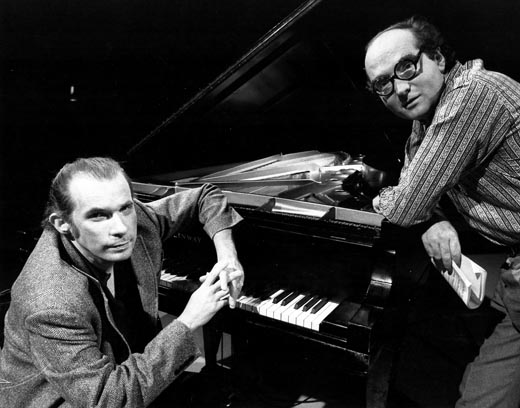
Glenn Gould, The Alchemist


Glenn GouldThe Alchemist. Bruno Monsaingeon (1974) - YouTube


Everything about Glenn Gould is full of meaning since he gives meaning to everything. In this film “The Alchemist”, we see him in several recording sessions in Toronto in 1974. At that time, for European connoisseurs the pianist, who lives in Toronto, is nothing but a distant legend. He stopped playing in concert at thirty-two, ten years previously, and his records are unobtainable in France. Monsaingeon, discovers him in 1966 when he buys a record in Moscow on which is written “Bach Inventions” and the name of the pianist which sounds vaguely familiar to him. It’s a revelation!

The Alchemist, the second part of Monsaingeon’s film, shows Glenn Gould hard at work recording; sparkling with intelligence and with an acute sense of self-mockery, he talks about his relations with the studio and his rejection of the concert, he evokes his fondness for technique which leads him to editing his own records. He does this while juggling between his piano, the editing and mixing tables and even between microphones.
“Recording is the only way I can play music for the public”. (Glenn Gould)


About...


Sunday, April 28, 2013

China - Nan-Kouan Music


Tsai Hsiao-Yueh - The Wind In the Sycamores
Courtly Ballads of Southern China

The Nan kuan repertoire was discovered in the West and in France in 1982 through the Dutch sinologist Kristofer Schipper. This discovery was a veritable revelation. Taiwan preserved court music from southern China that had disappear completely from that region and emigrated and took refuge in Taiwan under inexplicable circumstances. This genere has an aristocratic touch that has been maintained in the bourgeoisie of Taiwan and circles of its connoisseurs. This piece is composed of a chamber ensemble of four musicians. Two of them play the pipa and sanxian lutes, a third one a dongxiao vertical flute, and a fourth one an erxian two-strings bowed instrument. According to tradition the musicians sorround the solo female singer who conducts the ensemble with p'ai-pan clappers. Composed of ballads, the repertoires consist of courtly songs.


Saturday, April 27, 2013

Robert Burton - The Anatomy Of Melancholy (1621)


Melancholy, the subject of our present discourse, is either in disposition or in habit. In disposition, is that transitoryMelancholy which goes and comes upon every small occasion of sorrow, need, sickness, trouble, fear, grief, passion, or perturbation of the mind, any manner of care, discontent, or thought, which causes anguish, dulness, heaviness and vexation of spirit, any ways opposite to pleasure, mirth, joy, delight, causing forwardness in us, or a dislike. In which equivocal and improper sense, we call him melancholy, that is dull, sad, sour, lumpish, ill-disposed, solitary, any way moved, or displeased. And from these melancholy dispositions no man living is free, no Stoick, none so wise, none so happy, none so patient, so generous, so godly, so divine, that can vindicate himself; so well-composed, but more or less, some time or other, he feels the smart of it. Melancholy in this sense is the character of Mortality… This Melancholy of which we are to treat, is a habit, a serious ailment, a settled humour, as Aurelianus and others call it, not errant, but fixed: and as it was long increasing, so, now being (pleasant or painful) grown to a habit, it will hardly be removed. (Robert Burton)

About...


Book


Friday, April 26, 2013