Friday, June 14, 2013

Ted Hughes - Last Letter


Edward James "Ted" Hughes, OM (17 August 1930 – 28 October 1998) was an English poet and children's writer. Critics routinely rank him as one of the best poets of his generation.
Hughes was married to American poet Sylvia Plath, from 1956 until her suicide in 1963 at the age of 30. His part in the relationship became controversial to some feminists and (particularly) American admirers of Plath. His last poetic work, Birthday Letters (1998), explored their complex relationship. These poems make reference to Plath's suicide, but none of them addresses directly the circumstances of her death. A poem discovered in October 2010, Last letter, describes what happened during the three days leading up to Plath's suicide.
In 2008 The Times ranked Hughes fourth on their list of "The 50 greatest British writers since 1945".

Hughes and Plath had two children, Frieda Rebecca (1960) and Nicholas Farrar (1962) and in 1961, bought the house Court Green, in North Tawton, Devon. In the summer of 1962 Hughes began an affair with Assia Wevill who had been subletting the Primrose Hill flat with her husband. Under a cloud of his affair, Hughes and Plath separated in the autumn of 1962 and she set up life in a new flat with the children.

The death of Plath

Hughes' wife Sylvia Plath, beset by depression, and with a history of suicide attempts, took her own life on 11 February 1963, although it is unclear whether she meant to ultimately succeed. Hughes was devastated. In a letter to an old friend of Plath's from Smith College, he wrote, "That's the end of my life. The rest is posthumous." Some feminists argued that Hughes had driven Plath to suicide. Plath's gravestone was repeatedly vandalized by those aggrieved that "Hughes" is written on the stone and attempted to chisel it off, leaving only the name "Sylvia Plath." In 1970, radical feminist poet Robin Morgan published the poem "Arraignment", in which she openly accused Hughes of the battery and murder of Plath; other feminists threatened to kill him in Plath's name. In 1989, with Hughes under public attack, a battle raged in the letters pages of The Guardian and The Independent. In The Guardian on 20 April 1989 Hughes wrote the article "The Place Where Sylvia Plath Should Rest in Peace":
In the years soon after [Plath's] death, when scholars approached me, I tried to take their apparently serious concern for the truth about Sylvia Plath seriously. But I learned my lesson early... If I tried too hard to tell them exactly how something happened, in the hope of correcting some fantasy, I was quite likely to be accused of trying to suppress Free Speech. In general, my refusal to have anything to do with the Plath Fantasia has been regarded as an attempt to suppress Free Speech...The Fantasia about Sylvia Plath is more needed than the facts. Where that leaves respect for the truth of her life (and of mine), or for her memory, or for the literary tradition, I do not know.

As Plath's widower, Hughes became the executor of Plath’s personal and literary estates. He oversaw the publication of her manuscripts, including Ariel (1966). Some critics were dissatisfied by his choice of poem order and omissions in the book and some feminists argued that Hughes had essentially driven her to suicide and therefore should not be responsible for her literary legacy. He claimed to have destroyed the final volume of Plath’s journal, detailing their last few months together. In his foreword to The Journals of Sylvia Plath, he defends his actions as a consideration for the couple's young children.
On 25 March 1969, six years after Plath's suicide by asphyxiation from a gas stove, Assia Wevill committed suicide in the same way. Wevill also killed her child, Alexandra Tatiana Elise (nicknamed Shura), the four-year-old daughter of Hughes, born on 3 March 1965. Their deaths led to claims that Hughes had been abusive to both Plath and Wevill. In shock, Hughes could not finish the Crow sequence, which remained unfinished until the work Cave Birds was published in 1975. Crow, and the timing of its publication, seemed to underline Hughes's predisposition for dark violence, exemplified by the nature that he wrote about, red in tooth and claw.

Ted Hughes‘s previously unknown poem about Sylvia Plath‘s suicide has recently surfaced.
Full text of the poem after the jump.

“Last Letter”

What happened that night? Your final night.
Double, treble exposure
Over everything. Late afternoon, Friday,
My last sight of you alive.
Burning your letter to me, in the ashtray,
With that strange smile. Had I bungled your plan?
Had it surprised me sooner than you purposed?
Had I rushed it back to you too promptly?
One hour later—-you would have been gone
Where I could not have traced you.
I would have turned from your locked red door
That nobody would open
Still holding your letter,
A thunderbolt that could not earth itself.
That would have been electric shock treatment
For me.
Repeated over and over, all weekend,
As often as I read it, or thought of it.
That would have remade my brains, and my life.
The treatment that you planned needed some time.
I cannot imagine
How I would have got through that weekend.
I cannot imagine. Had you plotted it all?

Your note reached me too soon—-that same day,
Friday afternoon, posted in the morning.
The prevalent devils expedited it.
That was one more straw of ill-luck
Drawn against you by the Post-Office
And added to your load. I moved fast,
Through the snow-blue, February, London twilight.
Wept with relief when you opened the door.
A huddle of riddles in solution. Precocious tears
That failed to interpret to me, failed to divulge
Their real import. But what did you say
Over the smoking shards of that letter
So carefully annihilated, so calmly,
That let me release you, and leave you
To blow its ashes off your plan—-off the ashtray
Against which you would lean for me to read
The Doctor’s phone-number.
My escape
Had become such a hunted thing
Sleepless, hopeless, all its dreams exhausted,
Only wanting to be recaptured, only
Wanting to drop, out of its vacuum.
Two days of dangling nothing. Two days gratis.
Two days in no calendar, but stolen
From no world,
Beyond actuality, feeling, or name.

My love-life grabbed it. My numbed love-life
With its two mad needles,
Embroidering their rose, piercing and tugging
At their tapestry, their bloody tattoo
Somewhere behind my navel,
Treading that morass of emblazon,
Two mad needles, criss-crossing their stitches,
Selecting among my nerves
For their colours, refashioning me
Inside my own skin, each refashioning the other
With their self-caricatures,

Their obsessed in and out. Two women
Each with her needle.

That night
My dellarobbia Susan. I moved
With the circumspection
Of a flame in a fuse. My whole fury
Was an abandoned effort to blow up
The old globe where shadows bent over
My telltale track of ashes. I raced
From and from, face backwards, a film reversed,
Towards what? We went to Rugby St
Where you and I began.
Why did we go there? Of all places
Why did we go there? Perversity
In the artistry of our fate
Adjusted its refinements for you, for me
And for Susan. Solitaire
Played by the Minotaur of that maze
Even included Helen, in the ground-floor flat.
You had noted her—-a girl for a story.
You never met her. Few ever met her,
Except across the ears and raving mask
Of her Alsatian. You had not even glimpsed her.
You had only recoiled
When her demented animal crashed its weight
Against her door, as we slipped through the hallway;
And heard it choking on infinite German hatred.

That Sunday night she eased her door open
Its few permitted inches.
Susan greeted the black eyes, the unhappy
Overweight, lovely face, that peeped out
Across the little chain. The door closed.
We heard her consoling her jailor
Inside her cell, its kennel, where, days later,
She gassed her ferocious kapo, and herself.

Susan and I spent that night
In our wedding bed. I had not seen it
Since we lay there on our wedding day.
I did not take her back to my own bed.
It had occurred to me, your weekend over,
You might appear—-a surprise visitation.
Did you appear, to tap at my dark window?
So I stayed with Susan, hiding from you,
In our own wedding bed—-the same from which
Within three years she would be taken to die
In that same hospital where, within twelve hours,
I would find you dead.
Monday morning
I drove her to work, in the City,
Then parked my van North of Euston Road
And returned to where my telephone waited.

What happened that night, inside your hours,
Is as unknown as if it never happened.
What accumulation of your whole life,
Like effort unconscious, like birth
Pushing through the membrane of each slow second
Into the next, happened
Only as if it could not happen,
As if it was not happening. How often
Did the phone ring there in my empty room,
You hearing the ring in your receiver—-
At both ends the fading memory
Of a telephone ringing, in a brain
As if already dead. I count
How often you walked to the phone-booth
At the bottom of St George’s terrace.
You are there whenever I look, just turning
Out of Fitzroy Road, crossing over
Between the heaped up banks of dirty sugar.
In your long black coat,
With your plait coiled up at the back of your hair
You walk unable to move, or wake, and are
Already nobody walking
Walking by the railings under Primrose Hill
Towards the phone booth that can never be reached.
Before midnight. After midnight. Again.
Again. Again. And, near dawn, again.

At what position of the hands on my watch-face
Did your last attempt,
Already deeply past
My being able to hear it, shake the pillow
Of that empty bed? A last time
Lightly touch at my books, and my papers?
By the time I got there my phone was asleep.
The pillow innocent. My room slept,
Already filled with the snowlit morning light.
I lit my fire. I had got out my papers.
And I had started to write when the telephone
Jerked awake, in a jabbering alarm,
Remembering everything. It recovered in my hand.
Then a voice like a selected weapon
Or a measured injection,
Coolly delivered its four words
Deep into my ear: ‘Your wife is dead.’

and

Here 


Discovered in the British library 47 years after the death of his wife Sylvia Plath, here is Ted Hughes' "Last Letter" poem to Plath, read by Dave Stewart.


Thursday, June 13, 2013

Love Song n.3


Jesus Rueda - Love Song n.3 (from 5 Love Songs)
Ángela Rubio, cello & Clara Romero, piano


Wednesday, June 12, 2013

Life of Chopin, by Franz Liszt


To a people, always prompt in its recognition of genius, and ready to sympathize in the joys and woes of a truly great artist, this work will be one of exceeding interest. It is a short, glowing, and generous sketch, from the hand of Franz Liszt, (who, considered in the double light of composer and performer, has no living equal,) of the original and romantic Chopin; the most ethereal, subtle, and delicate among our modern tone-poets.

Book english
Here 
Here 

Book spanish
Here 


Chopin Documentary - The Women Behind The Music


Tuesday, June 11, 2013

Very Old Recordings 6 - Ravel, Saint-Saëns and Rachmaninoff


Ravel plays Ravel
Valses Nobles et Sentimentales (1913 Welte Mignon Recording)

Saint-Saens plays Saint-Saens
Valse Mignonne (Rec.1919 Welte Mignon)

Rachmaninoff plays "The Swan" by Saint-Saëns (1924)


Monday, June 10, 2013

Jean Giono - The Man Who Planted Trees


The Man Who Planted Trees (French title L'homme qui plantait des arbres), also known as The Story of Elzéard Bouffier, The Most Extraordinary Character I Ever Met, and The Man Who Planted Hope and Reaped Happiness, is an allegorical tale by French author Jean Giono, published in 1953.
It tells the story of one shepherd's long and successful singlehanded effort to re-forest a desolate valley in the foothills of the Alps in Provence throughout the first half of the 20th century. The tale is quite short—only about 4000 words long. It was composed in French, but first published in English.

The story begins in the year 1910, when this young man is undertaking a lone hiking trip through Provence, France, and into the Alps, enjoying the relatively unspoiled wilderness.
The narrator runs out of water in a treeless, desolate valley where only wild lavender grows and there is no trace of civilization except old, empty crumbling buildings. The narrator finds only a dried up well, but is saved by a middle-aged shepherd who takes him to a spring he knows of.
Curious about this man and why he has chosen such a lonely life, the narrator stays with him for a time. The shepherd, after being widowed, has decided to restore the ruined landscape of the isolated and largely abandoned valley by single-handedly cultivating a forest, tree by tree. The shepherd, Elzéard Bouffier, makes holes in the ground with his curling pole and drops into the holes acorns that he has collected from many miles away...

"L'homme qui plantait des arbes," 1987, Canada, Frederic Back, story by Jean Giono 

Sunday, June 9, 2013

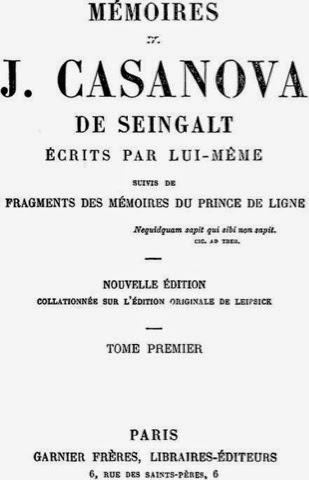
Giacomo Casanova - Memoirs


The memoirs open with:
"I begin by declaring to my reader that, by everything good or bad that I have done throughout my life, I am sure that I have earned merit or incurred guilt, and that hence I must consider myself a free agent. ... Despite an excellent moral foundation, the inevitable fruit of the divine principles which were rooted in my heart, I was all my life the victim of my senses; I have delighted in going astray and I have constantly lived in error, with no other consolation than that of knowing I have erred. ... My follies are the follies of youth. You will see that I laugh at them, and if you are kind you will laugh at them with me."

Giacomo Girolamo Casanova (2 April 1725 – 4 June 1798) was an Italian adventurer and author from the Republic of Venice. His autobiography, Histoire de ma vie (Story of My Life), is regarded as one of the most authentic sources of the customs and norms of European social life during the 18th century.
As was not uncommon at the time, Casanova often used pseudonyms, the most frequent being Chevalier de Seingalt (pronounced Saint-Galle as in French). He also published abundantly in French under the name Jacques Casanova de Seingalt.
He has become so famous for his often complicated and elaborate affairs with women that his name is now synonymous with "womanizer". He associated with European royalty, popes and cardinals, along with luminaries such as Voltaire, Goethe and Mozart. He spent his last years in Bohemia as a librarian in Count Waldstein's household, where he also wrote the story of his life.

The main authority for Casanova's life is his Mémoires (12 vols., Leipzig, 1826-38), which were written at Dux. They are clever, well written and, above all, cynical, and interesting as a trustworthy picture of the morals and manners of the times. Among Casanova's other works may be mentioned Confutazione della storia del governo Veneto d'Amelot de la Houssaye (Amsterdam, 1769), an attempt to ingratiate himself with the Venetian government; and the Histoire of his escape from prison (Leipzig, 1788).

Book english (complete)
Here 
Here 
Here 

Book spanish


Saturday, June 8, 2013

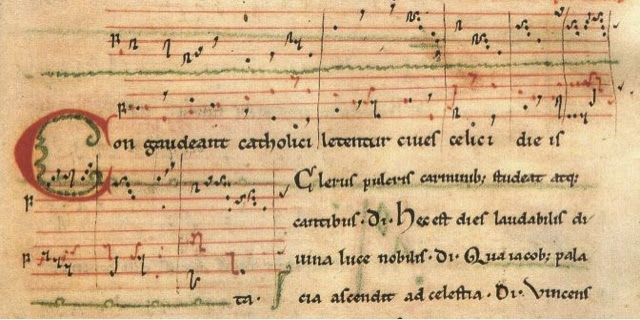
Medieval Spain 5 - Codex Calixtinus


The Codex Calixtinus is a 12th-century illuminated manuscript formerly attributed to Pope Callixtus II, though now believed to have been arranged by the French scholar Aymeric Picaud. The principal author is actually given as 'Scriptor I'.
It was intended as an anthology of background detail and advice for pilgrims following the Way of St. James to the shrine of the apostle Saint James the Great, located in the cathedral of Santiago de Compostela, Galicia (Spain). The codex is alternatively known as the Liber Sancti Jacobi, or the Book of Saint James. The collection includes sermons, reports of miracles and liturgical texts associated with Saint James, and a most interesting set of polyphonic musical pìeces. In it are also found descriptions of the route, works of art to be seen along the way, and the customs of the local people.
The book was stolen from its security case in the cathedral's archives on 3 July 2011 and retrieved almost exactly a year later on 4 July 2012.

The Codex Calixtinus was intended to be chanted aloud and is of great interest to musicologists as an early example of polyphony. In particular, it contains the first known composition for three voices, the conductus Congaudeant catholici (Let all Catholics rejoice together); however, the extreme dissonance encountered when performing all three voices together has led some scholars to suggest that this was not the original intention. The popularity of the music has continued to the present day with modern recordings commercially available.


Congaudeant Catholici

O Adiutor Seculorum
Coro de Monjes del Monasterio de Santo Domingo de Silos (1969)

Ad Vesperas Sancti Iacobi
Ensemble Organum. Dir, Marcel Pérès


Friday, June 7, 2013

Twilight


Photo, Mette Perregaard

Jesus Rueda - Twilight (from Copenhagen Sketches)
Jesus Rueda, piano


Thursday, June 6, 2013

Sardinia - Tenores di Bitti


The Tenores di Bitti are a traditional folk music group from Bitti, Sardinia who employ a polyphonic vocal style, often described as a type of overtone singing, whose oral tradition dates back to 3000 BC.
They extemporize or perform poems with each singer taking one of four parts: boke, bassu, contra, or mea'oke. Boke is the soloist and provides melody, bassu is the root and provides the tonic, contra provides the fifth, and mea'oke provides the octave above the fifth, filling out an chord in just intonation. There are in Bitti more "a tenore" groups and the most famous are Tenores di Bitti Mialinu Pira and Tenores di Bitti remunnu 'e Locu.

Another matter to be pointed is their accuracy in choosing lyrics. Both in dancing (lestru, dillu, seriu, passu torrau,) and slow (isterrita, boch'e notte) forms, the lyrics , by famous poets or from misknown contemporary authors, make the repertoire of Tenores di Bitti “Mialinu Pira” an important vehicle of literary transmission. These songs are profane poems speaking about the shepherds and their solitude in touch with the nature, referring to the popular world and its traditions.

The a cantu a tenore was proclaimed by the UNESCO  in 2005  "Masterpieces of the Oral and Intangible Heritage of Humanity"

Oficial Web (Tenores Mialinu Pira)
Examples (Tenores Remunnu 'e Locu)


Tenores di Bitti "Mialinu Pira" - Milia vattu sa Trota

Tenore di Bitti Remunnu 'e Locu -Sa bellesa de Clori-


Wednesday, June 5, 2013

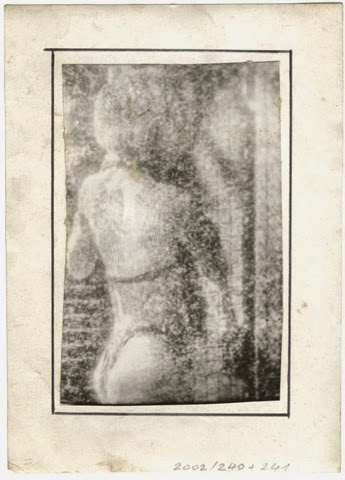
The Homeless Photographer - Miroslav Tichý


Miroslav Tichý (November 20, 1926 – April 12, 2011) was a photographer who from the 1960s until 1985 took thousands of surreptitious pictures of women in his hometown of Kyjov in the Czech Republic, using homemade cameras constructed of cardboard tubes, tin cans and other at-hand materials. Most of his subjects were unaware they are being photographed. A few struck beauty-pageant poses when they sighted him, perhaps not realizing that the parody of a camera he carried was real.
His soft focus, fleeting glimpses of the women of Kyjov are skewed, spotted and badly printed — flawed by the limitations of his primitive equipment and a series of deliberate processing mistakes meant to add poetic imperfections.
Of his technical methods, Tichy has said, "First of all, you have to have a bad camera", and, "If you want to be famous, you must do something more badly than anybody in the entire world."
During the Communist regime in Czechoslovakia, Tichý was considered a dissident and badly treated by the government. His photographs remained largely unknown until an exhibition was held for him in 2004. Tichý did not attend exhibitions, and lived a life of self-sufficiency and freedom from the standards of society.

About...


About (spanish)...


Tuesday, June 4, 2013

Sunday, June 2, 2013

Obsesión


Jesus Rueda: OBSESIÓN played by Marco Cresci - clarinet
Bilbao Euskaluna Auditorium in 2004


Saturday, June 1, 2013

Gambie - L'Art De La Kora


Jali Nyama Suso : Kuruntu Kelefa et Kelefabaa
From the Ocora album release "Gambie - L'Art De La Kora" recorded April 1972, Concert Hall, School of Music, University of Washington.


Jali Nyama Suso, The Gambia's legendary kora player, for twenty years well known for his weekly program on Radio Gambia, touring England, France, Sweden, and Germany in the 1980s, died in 1991. In 1971 he recorded the first solo kora album, later re-released as a CD (here), containing three new recordings with Jali Nyama and other musicians in Gambia in 1970.

Suso has probably done more than any other musician to promote the kora/jali tradition outside of Africa. He was a competent kora player by age eight; at 16, a fall cost him a leg, rendering him unable to follow the normal jali existence of traveling around and performing at various ceremonies. He started recording for the radio in 1956 and was a national star by the mid-'60s, even being hired to arrange the national anthem. He worked with American musicologists, leading to a teaching job in the U.S., where he was featured on the Roots soundtrack. In the late '70s, he traveled around Sweden, performing for devoted fans. He contracted tuberculosis in 1986, which eventually led to his death in 1991. ~ Steve Huey, Rovi