Showing posts with label Film. Show all posts

Sunday, June 23, 2013

Balzac - The Unknown Masterpiece


In 1927, Picasso's dealer Ambroise Vollard commissioned the artist to illustrate a special re-edition of Balzac's 1837 short story, "The Unknown Masterpiece".
Balzac's story is set in the Seventeenth century at a studio in the rue des Grandes-Augustins in Paris. It unfolds around an aging artist called Frenhofer, who is the greatest painter of his day. Frenhofer reveals to two of his ardent admirers, Pourbus and Poussin, that he has been working on a secret painting which has for years consumed all his creative powers. Pourbus and Poussin then scheme to get Frenhofer to show them the painting by procuring a beautiful young model for its completion. When they finally see the Unknown Masterpiece it appears to be nothing but a mess of lines and layers of paint which they immediately interpret as being the work of a raving madman.

Picasso identified with Frenhofer and was fascinated by Balzac's eerie story. In the 1930's, as if by a strange twist of fate, he rented Nº 7 rue des Grandes-Augustin, which he and others believed to be the the house in which the story begins. It was at this address in 1937, exactly one hundred years after Balzac's final version, that Picasso painted his most famous masterpiece - Guernica.

Picasso later claimed to have been haunted by Balzac; and there seem to be strange parallels between Frenhofer's Unknown Masterpiece and the 1934 drawing. As with Frenhofer's painting, the drawing seems to be the product of an extraordinary creative process. Its existence also appears to have been kept a closely guarded secret. Similarly, at first encounter, the drawing appears to be a mess of lines and smudged inks, yet what it contains is probably the most complete convergence of themes in the entire range of Picasso's work. For these reasons, it seems that the drawing was probably intended to be Picasso's version of the Unknown Masterpiece. © Mark Harris 1996

English formats
Pdf 

Book spanish pdf
Here and Here

Book French
Here 


Based on Honore de Balzac's "Le chef-d'oeuvre inconnu" (or The Unknown masterpiece), La Belle Noiseuse is a 1991 film directed by Jacques Rivette and starring Michel Piccoli as the distressed artist, obsessed with something that will never exist: The perfect and flawless artistic masterpiece.


Monday, June 17, 2013

James Joyce - Ulysses


Joyce first encountered Odysseus in Charles Lamb's Adventures of Ulysses—an adaptation of the Odyssey for children, which seemed to establish the Roman name in Joyce's mind. At school he wrote an essay on Ulysses entitled "My Favourite Hero". Joyce told Frank Budgen that he considered Ulysses the only all-round character in literature. He thought about calling Dubliners by the name Ulysses in Dublin, but the idea grew from a story in Dubliners in 1906, to a "short book" in 1907, to the vast novel that he began in 1914.

Book english
Here 
Here 

Book spanish
Here 


Ulysses


Monday, June 10, 2013

Jean Giono - The Man Who Planted Trees


The Man Who Planted Trees (French title L'homme qui plantait des arbres), also known as The Story of Elzéard Bouffier, The Most Extraordinary Character I Ever Met, and The Man Who Planted Hope and Reaped Happiness, is an allegorical tale by French author Jean Giono, published in 1953.
It tells the story of one shepherd's long and successful singlehanded effort to re-forest a desolate valley in the foothills of the Alps in Provence throughout the first half of the 20th century. The tale is quite short—only about 4000 words long. It was composed in French, but first published in English.

The story begins in the year 1910, when this young man is undertaking a lone hiking trip through Provence, France, and into the Alps, enjoying the relatively unspoiled wilderness.
The narrator runs out of water in a treeless, desolate valley where only wild lavender grows and there is no trace of civilization except old, empty crumbling buildings. The narrator finds only a dried up well, but is saved by a middle-aged shepherd who takes him to a spring he knows of.
Curious about this man and why he has chosen such a lonely life, the narrator stays with him for a time. The shepherd, after being widowed, has decided to restore the ruined landscape of the isolated and largely abandoned valley by single-handedly cultivating a forest, tree by tree. The shepherd, Elzéard Bouffier, makes holes in the ground with his curling pole and drops into the holes acorns that he has collected from many miles away...

"L'homme qui plantait des arbes," 1987, Canada, Frederic Back, story by Jean Giono 

Sunday, June 9, 2013

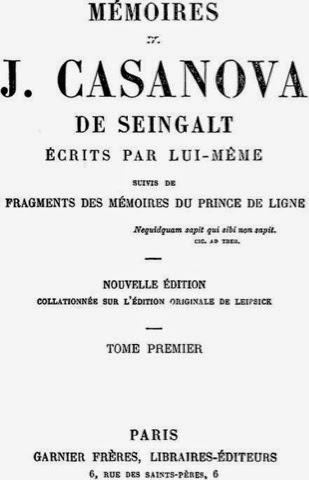
Giacomo Casanova - Memoirs


The memoirs open with:
"I begin by declaring to my reader that, by everything good or bad that I have done throughout my life, I am sure that I have earned merit or incurred guilt, and that hence I must consider myself a free agent. ... Despite an excellent moral foundation, the inevitable fruit of the divine principles which were rooted in my heart, I was all my life the victim of my senses; I have delighted in going astray and I have constantly lived in error, with no other consolation than that of knowing I have erred. ... My follies are the follies of youth. You will see that I laugh at them, and if you are kind you will laugh at them with me."

Giacomo Girolamo Casanova (2 April 1725 – 4 June 1798) was an Italian adventurer and author from the Republic of Venice. His autobiography, Histoire de ma vie (Story of My Life), is regarded as one of the most authentic sources of the customs and norms of European social life during the 18th century.
As was not uncommon at the time, Casanova often used pseudonyms, the most frequent being Chevalier de Seingalt (pronounced Saint-Galle as in French). He also published abundantly in French under the name Jacques Casanova de Seingalt.
He has become so famous for his often complicated and elaborate affairs with women that his name is now synonymous with "womanizer". He associated with European royalty, popes and cardinals, along with luminaries such as Voltaire, Goethe and Mozart. He spent his last years in Bohemia as a librarian in Count Waldstein's household, where he also wrote the story of his life.

The main authority for Casanova's life is his Mémoires (12 vols., Leipzig, 1826-38), which were written at Dux. They are clever, well written and, above all, cynical, and interesting as a trustworthy picture of the morals and manners of the times. Among Casanova's other works may be mentioned Confutazione della storia del governo Veneto d'Amelot de la Houssaye (Amsterdam, 1769), an attempt to ingratiate himself with the Venetian government; and the Histoire of his escape from prison (Leipzig, 1788).

Book english (complete)
Here 
Here 
Here 

Book spanish